


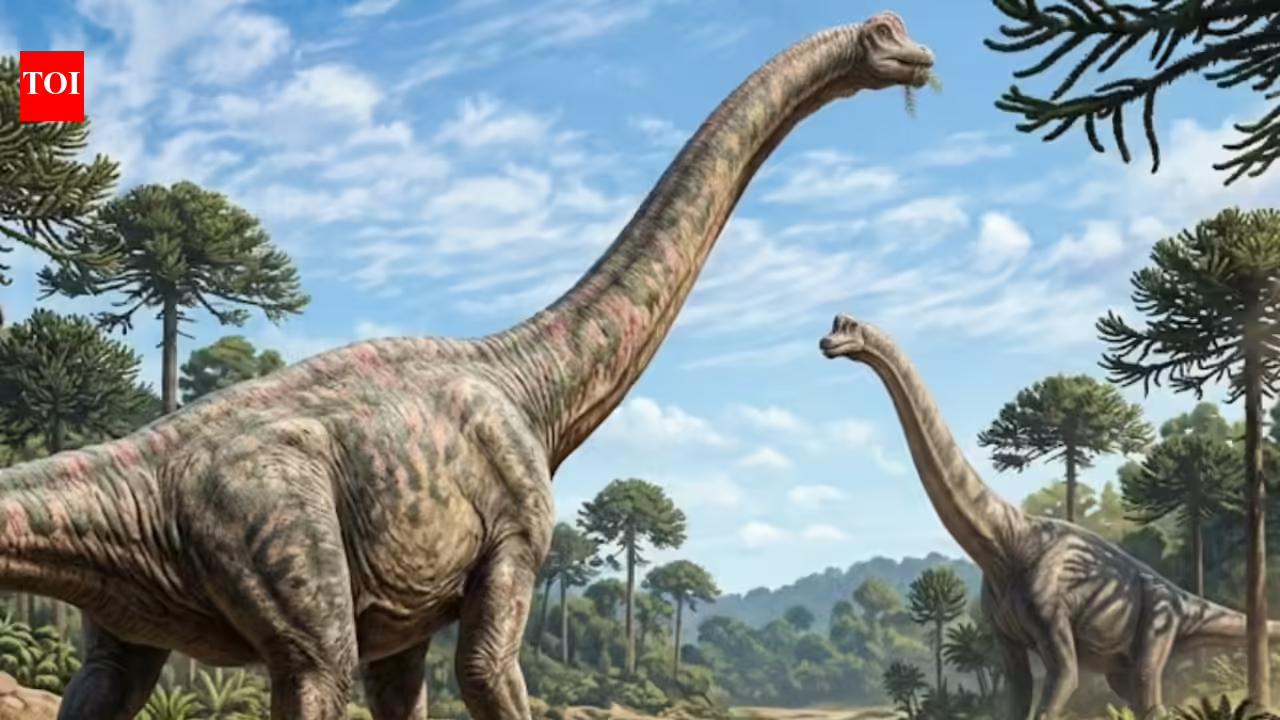
Imagine digging out the foundations of a brand new structure and accidentally hitting something that’s never been exposed to sunlight in the past 120 million years. The bustling city of Davinopolis, situated within the Brazilian state of Maranhao, which began as regular environmental monitoring as part of an upcoming construction project, became one of the biggest discoveries of palaeontology of South American history. In the shadows of eight meters beneath the surface are the skeletons of a massive creature that challenges our understanding of the way life traveled throughout the world prior to the continents being as large as they are now.It’s more than just a pile of bones. This is an entirely new dinosaur species, one with a neck that extended 65 feet from tail to head. The scientists have named it Dasosaurus tocantinensis, the name honors the lush forests in the region as well as the nearby Tocantins River. Researchers who spent decades tracing this fragile rock from granite, the find is a reminder of how the surface we step on is a place that’s much more ancient and far from what the imagination of.A giant traveler between lost worldsDasosaurus’s story is much more than an account of a massive creature; it’s the story of a wanderer. Through studying the unique design of its vertebrae, as well as its enormous 1.5-meter femur, scientists realized that they had spotted an animal belonging to the sauropod species. They were the famous plant eaters of prehistoric times, distinguished by their small heads and strong tails that helped counterbalance their huge bodies.The thing that makes this find really shocking is the person this dinosaur has a connection to. In a study within Journal of Systematic Palaeontologythe closest cousin of the Brazilian dinosaur was actually found in the region that is today Spain. This is an intriguing mystery for geologists. If family members with the closest proximity resided thousands of miles from Europe, how did they arrive in South America?The answer is in the supercontinent that was once Gondwana. At the time of Gondwana’s Early Cretaceous period, South America, Africa, Antarctica, and India were still in a tangle. Europe was, at that time, an island of islands. Researchers believe that, between 140 and 120 million years ago ancestral ancestors of Dasosaurus most likely moved from Europe across Africa before crossing into South America via land bridges, which are now buried under the Atlantic Ocean. This finding provides proof for the old “land pathways,” showing that dinosaurs were among the most explorers of all time.
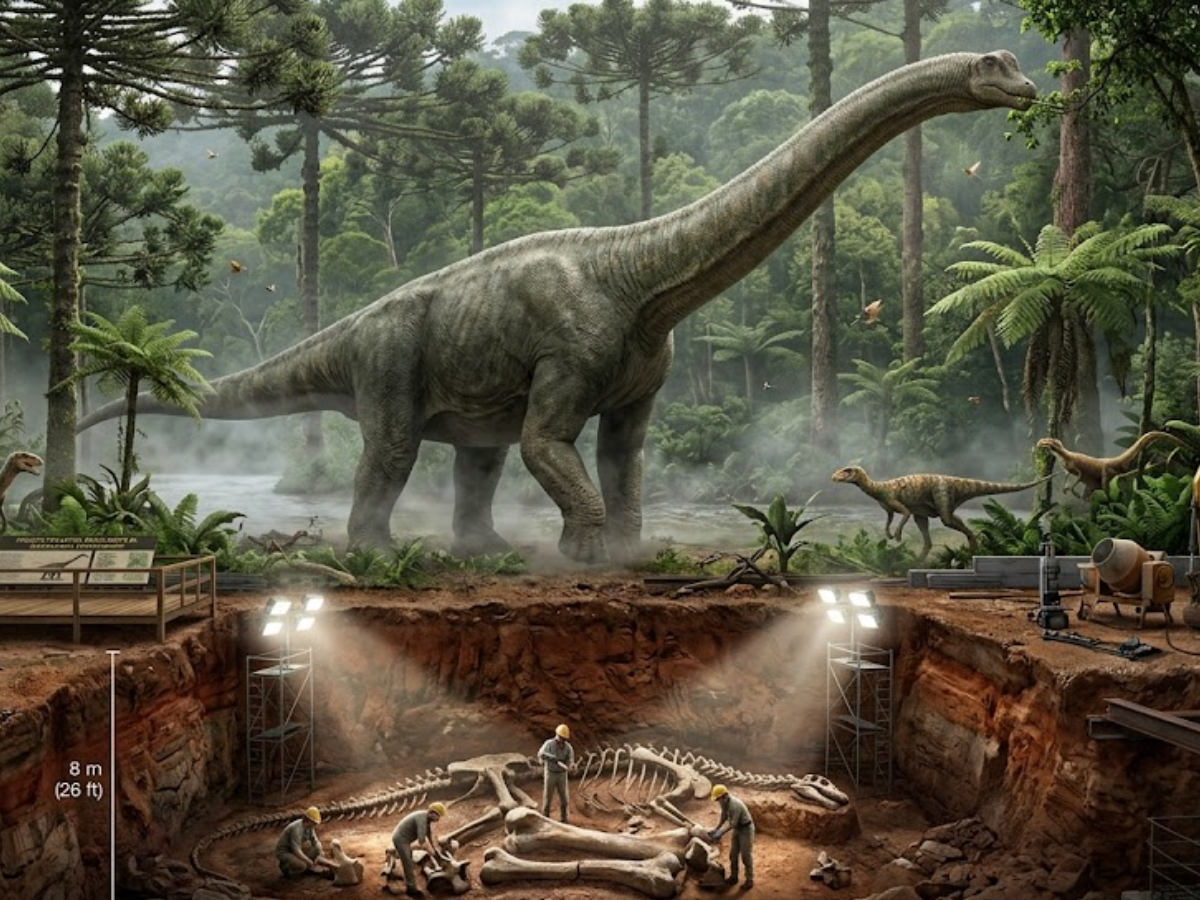
This discovery also sheds light on the biological mechanisms behind the immense growth of sauropods. Image Credit: Gemini
The hidden science of growing a titanBeyond its journey, Dasosaurus is teaching scientists about the biological “blueprints” of being large. The size of a bus is a feat that requires a unique biological process. If a dinosaur develops in a way that is too slow, it will become a tempting food source for prey. If it expands too rapidly and does not have the proper bone structure, its weight could crush its legs.Through analyzing the microstructure of fossils, the researchers discovered growth patterns which are able to bridge the gap between sauropods and the more gigantic titanosaurs which ruled during the last times of the dinosaur age. The research, entitled The discovery of a new basal sauropod found in the Lower Cretaceous of Brazil, reveals how specific bones that were designed to be sturdy and lightweight evolved before what we believed. The “internal structures” enabled Dasosaurus to grow enormously and still maintain the flexibility needed for survival within the dense, tangled woodlands of early Brazil.Professor Elver Luiz Mayer from The Federal University of the São Francisco Valley, explains that even though Maranhao has produced smaller species such as the 10-meter Amazonsaurus., nothing of this size had ever previously been discovered before this discovery. The completeness of this find, including arms bones, ribs, as well as foot bones, offers the first high-definition, rare look at an animal which was previously merely an anomaly in fossil records.Why construction sites are palaeontology’s best friendThere’s an element of irony in the way this massive discovery was made. In a country with a high temperature, such as Brazil, with its thick vegetation and soil layers that conceal the rock, scientists usually aren’t able to see the ground beneath their feet. According to Professor Max Langer from the University of São Paulo, a lot of Brazil’s most impressive fossil discoveries are the result of human-caused activity. Roads, quarries and massive building projects serve as accidental excavations which reveal the remains of rocks which have been hidden for aeons.This “accidental” discovery process has its own risks. The laws in Brazil call for monitoring on construction sites, a lot of fossils could be crushed by bulldozers long before people realize that they exist. The accomplishment that was achieved by the Dasosaurus recovery is an opportunity to improve co-operation between researchers and developers. If it weren’t for the attentiveness of the screens at Davinopolis, this massive 65-foot structure could have turned into dirt rather than an impressive museum centrepiece.Presently, the remains of Dasosaurus tocantinensis can be found at São Luís at the State Center for Natural History and Archeology Research. They are a testimony to the time in which the globe was a single connected mass of land, and let us know that beneath the sandstone of a contemporary construction site, an ancient legend could be waiting to be discovered.