


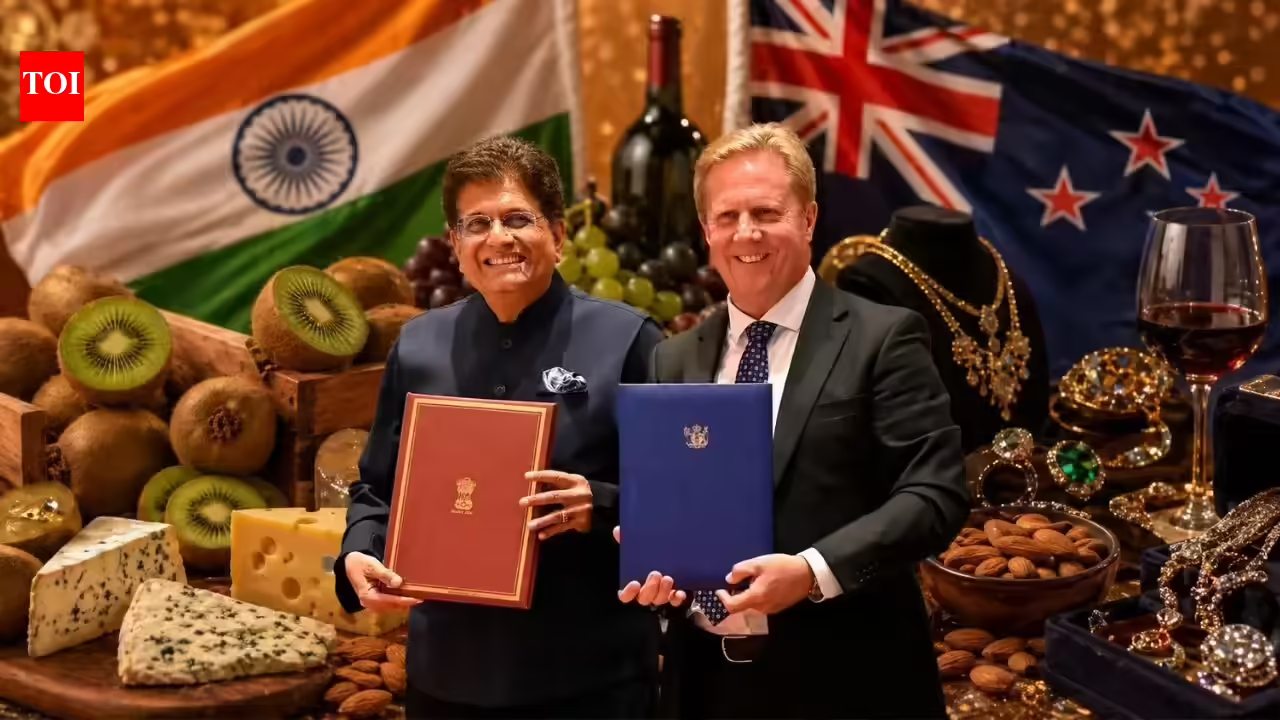
India-New Zealand FTA: The India-New Zealand trade deal or Free Trade Agreement signed on Monday has been called a ‘once-in-a-generation’ trade pact. For one, it gives Indian exporters duty-free or zero duty access to all exports. The implementation of the trade deal is now contingent on New Zealand Parliament’s approval, and in the case of India the Cabinet’s nod.The FTA was signed by Commerce and Industry Minister Piyush Goyal and New Zealand’s Trade and Investment Minister Todd McClay in Delhi. The trade deal is expected to help double the bilateral trade between the two countries to $5 billion in five years.Posting on It will open new avenues for growth, create opportunities and deepen our synergy across sectors. The investment commitment of $20 billion by New Zealand will further strengthen our cooperation in agriculture, manufacturing, innovation and technology, paving the way for a more prosperous and dynamic future for both countries.“New Zealand on its part has called the trade deal a ‘once-in-a-generation agreement’, providing it access to an economy which is set to be the third largest in the coming years. Another point that stands out is that the FTA is being called one of the fastest concluded by India with a developed country. Through five formal rounds of negotiations and several intersessions, both sides concluded the Agreement on 22 December 2025, just nine months after launch, making it one of the fastest FTAs concluded by India with a developed country, the government release says.
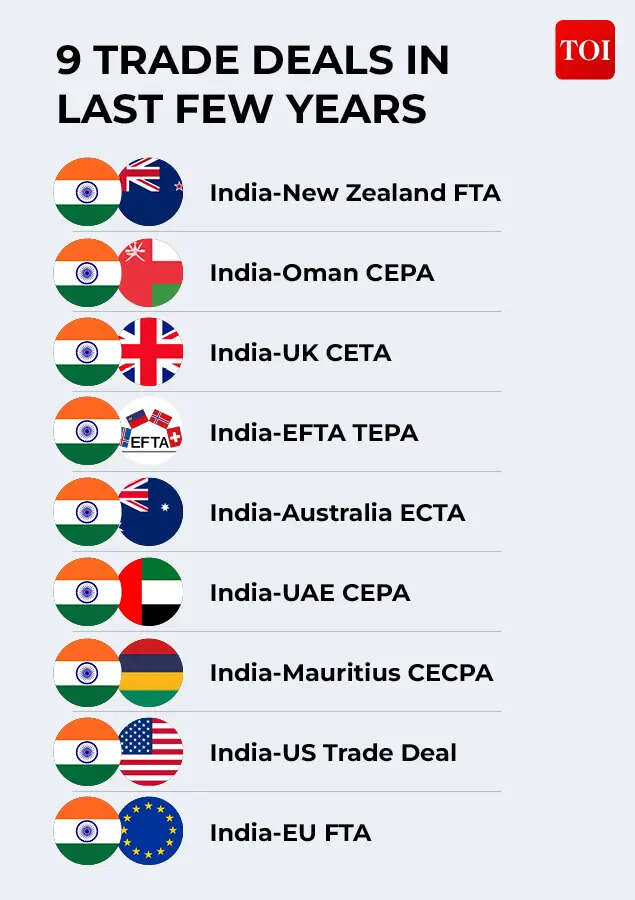
India is on a trade deal signing spree, a fact highlighted by Piyush Goyal during the signing. According to Goyal, this is India’s ninth trade agreement in the last few years.
India-New Zealand Trade in Numbers
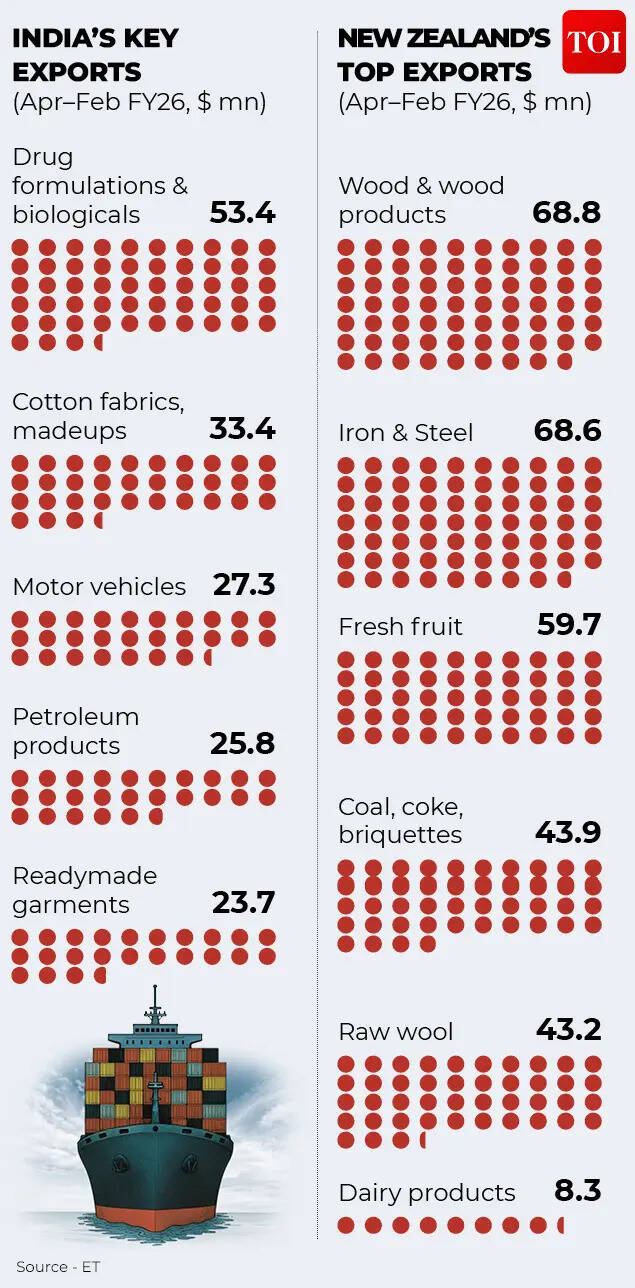
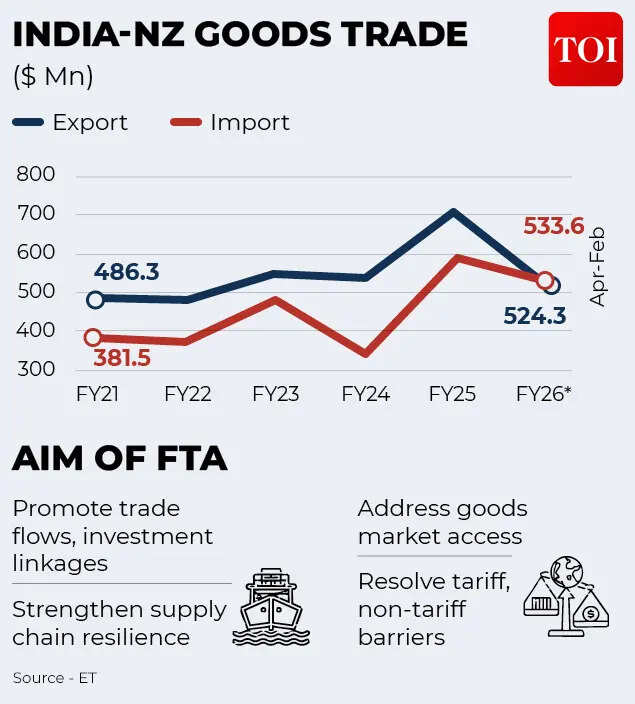
As of 2024, the bilateral trade between India and New Zealand is at around $2.4 billion. This includes both goods and services, of which $1.24 billion is services trade led by IT, travel, and business services. The merchandise trade in 2024-25 was at around $1.3 billion, which includes $711.11 million in exports and $587.13 million in imports.This figure is expected to double in the coming years after the India-New Zealand FTA comes into effect.At present, some of the sectors India exports products to New Zealand include: petroleum products, pharmaceuticals, aviation fuel, readymade garments, machinery, and aviation fuel. It imports scrap metals, coal and farm-linked inputs, iron and steel, select dairy products, wood and wood products.
India-New Zealand FTA: Salient Points
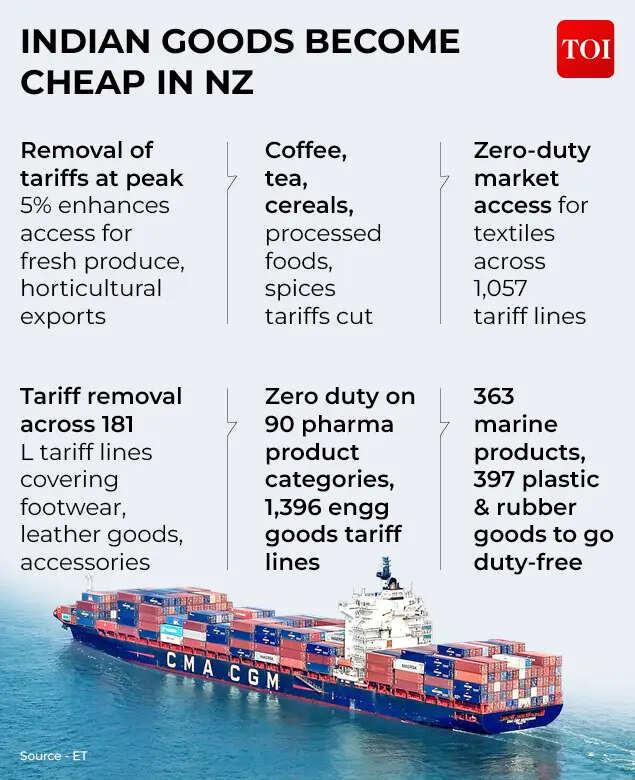
Layered tariff systemThe agreement has introduced a tiered tariff system for industrial and manufactured goods, rather than a one-size-fits-all approach. New Zealand provides 100% duty-free access to all Indian exports, covering sectors like textiles, leather, engineering goods and manufacturing products. In return, India opens up around 70% of its tariff lines, accounting for 95% of trade value, but does so in stages. Some goods see immediate duty removal, while others follow phased reductions over 3, 5, 7 or 10 years, and a small category gets partial tariff cuts. The structure also includes concessional access for inputs such as wooden logs, coking coal and metal scrap, forming part of a clearly defined and time-bound tariff roadmap.Sectors at playThe agreement lays out a detailed services framework, where New Zealand commits market access across around 118 sectors, including IT, finance, education, telecom, tourism and professional services. These commitments are defined through structured schedules that specify how and where service providers can operate. A key feature here is the Most-Favoured Nation (MFN) clause across about 139 sub-sectors. In simple terms, if New Zealand offers better terms to another country in the future in these areas, the same conditions can be extended to India. This ensures the services chapter remains dynamic and adaptable over time.Protection for these sectorsHowever, not everything is opened up, and that’s built directly into the agreement! India has kept around 30% of sensitive products completely excluded from the agreement. This includes dairy (milk, cream, whey, yoghurt, cheese), animal products (other than sheep meat), agri goods (onions, chana, peas, corn, almonds), sugar, artificial honey, animal, vegetable or microbial fats and oils, arms and ammunition, gems and jewellery, copper and articles (cathodes, cartridges, rods, bars, coils), aluminum and articles (ingots, billets, wire bars).
Quota for KiwisThe agreement places edible and agricultural trade under a tightly controlled system rather than full liberalisation. Major food imports such as apples, kiwifruit, Mānuka honey and milk albumin are allowed only through Tariff Rate Quotas (TRQs), to protect domestic farmers. This means that fixed quantities can enter at lower duties, while anything beyond that faces higher tariffs. Now, these quotas are further regulated through Minimum Import Prices (MIP), seasonal windows, and phased duty reductions, creating multiple layers of control. And what about your ‘spirits’?Under the deal, India will get duty-free access for its wine and spirits exports to New Zealand. At the same time, wines coming from the Kiwi nation to New Delhi will face a reduced tariff that will be gradually lowered over the next 10 years.People in pactMobility is built into the agreement through a multi-layered visa and movement framework. It introduces a Temporary Employment Entry pathway, allowing up to 5,000 Indian professionals at a time to work in New Zealand for up to three years across specified occupations. There is also a student mobility system, which removes caps on Indian students, allows part-time work during studies, and defines post-study work durations based on qualification levels. In addition, a Working Holiday Visa scheme enables 1,000 young Indians each year to travel and work for up to 12 months. Together, these elements form a structured system governing temporary movement across categories.Talking investmentThe agreement includes a long-term investment framework, with a commitment to facilitate $20 billion into India over a 15-year period. It outlines mechanisms for promoting bilateral investment, including cooperation in technology, research and skill development. A notable feature is the “rebalancing clause”, which provides a formal mechanism to review and address any shortfall in investment commitments. These provisions are supported by institutional arrangements designed to coordinate and monitor investment-related engagement between the two countries.
RegulationsWhat actually makes an FTA work on the ground? It’s these behind-the-scenes rules, and this agreement between India and New Zealand puts strong systems in place. In pharmaceuticals and medical devices, there are faster approval pathways and recognition of inspections from trusted regulators like the US, EU, UK, and Canada, meaning that Indian products can reach markets quicker. On intellectual property, New Zealand has committed to updating its laws within 18 months to give European-level protection to India’s Geographical Indications (GIs). Trade processes are also set to become more efficient, with advance rulings, digital paperwork, and customs clearance within 48 hours and even 24 hours for perishables. Now add to that a strict Rules of Origin framework, and the deal ensures that only genuine goods benefit, preventing misuse while keeping trade fair and transparent.
How it Benefits India – Experts Explain
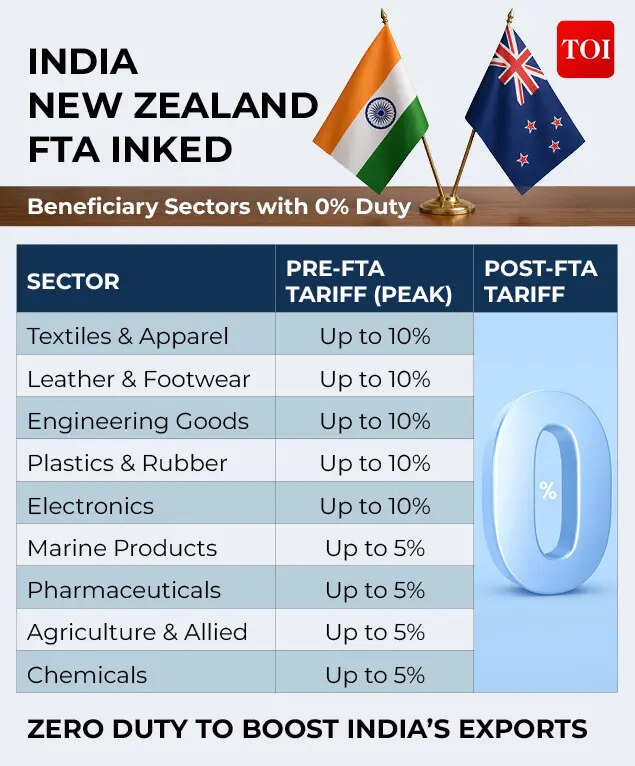
To put it simply, all of India’s exports to New Zealand will now face zero duty. Sectors which will in particular benefit are labour-intensive ones such as All Indian goods, including labour-intensive sectors like leather and engineering goods, footwear, plastics items, and importantly textiles.It’s interesting to note that India has adopted a calibrated approach, with immediate elimination on 30% of tariff lines, phased reductions on 35.6%, and exclusions for sensitive sectors such as dairy and key agricultural products.
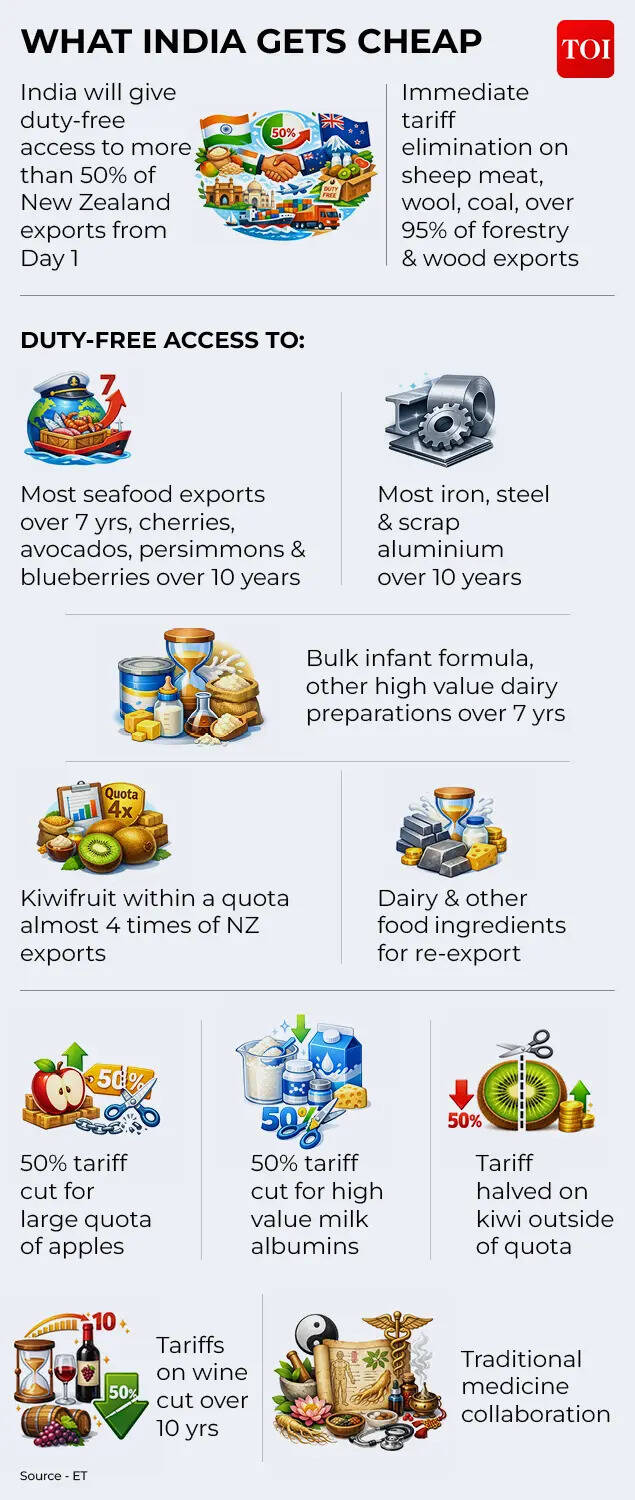
PwC is of the view that tariff‑rate quotas with minimum import prices safeguard domestic farmers, while explicit recognition of AYUSH and related wellness services expands opportunities for Indian practitioners in New Zealand.Commitments have been made by New Zealand for investments of $20 billion in 15 years and these will help a wide range of sectors such as education, tourism, construction, financial services, IT and IT-enabled services, and professional services.Explaining the benefits of the trade deal, Agneshwar Sen, Trade Policy leader at EY India says, “New Zealand’s offer to eliminate duties on 100% of its tariff lines upon entry into force of the agreement, covering all 8,284 lines, means Indian goods in textiles, apparel, leather, pharmaceuticals, machinery, and auto components enter New Zealand duty-free, erasing an average applied tariff of 2.2%. It may be noted that the average includes a 10% tariff on some of our labor intensive exports like clothing and leather products, which also now get the tariff free treatment.“Crucially, India has secured this without compromising its most sensitive sectors. Dairy, edible oils, sugar, spices, onions, and key agricultural commodities are explicitly excluded from India’s concession list, protecting domestic farmers and industry. India’s concessions on the other hand are targeted: eliminating tariffs on sheep meat, wool, coal, and forestry products – inputs that support Indian manufacturing rather than threaten it.“Beyond goods, the agreement opens mobility pathways for Indian professionals in IT, healthcare, engineering, and education, while a dedicated fast-track arrangement allows Indian food processors to import New Zealand ingredients duty-free for processing and re-export — directly supporting India’s ambition to become a Global Food Hub. With merchandise exports to New Zealand already on an upward trend, this FTA provides policy certainty and assured market access to sustain that momentum,” Sen explains.According to Gulzar Didwania, Partner, Deloitte India, from India’s perspective, the investment commitment of around $20 billion creates investment opportunities in agri technology, food processing, logistics and services through a structured investment facilitation framework. “Importantly, it reflects a shift away from tariff-led liberalization towards productivity, capability building and long-term cooperation,” Didwania says.
Anurag Sehgal, Principal -Price Waterhouse & Co LLP is of the view that the real value of the FTA depends on corporate initiative. “To convert this agreement into a sustainable commercial advantage, firms may now look at examining and, if required, recalibrating manufacturing footprints, as building the resilient bilateral supply chains would be central to maximize the benefits of the next-generation trade framework being calibrated by India through its new FTAs,” he says.One very important part of the FTA is the mobility aspect. The trade agreement opens avenues for skilled employment of Indians in New Zealand with a quota of 5,000 visas at any given time which will allow for a stay of up to 3 years.Amarpal Chadha, Tax Partner at EY India explains that the inclusion of high demand sectors such as IT, engineering, healthcare, alongside iconic Indian occupations like AYUSH practitioners, yoga instructors, reflects a deliberate focus on services‑led growth and workforce collaboration. In addition, the introduction of an annual Working Holiday Visa quota of 1,000 young Indians, permitting multiple entry for up to 12 months, further strengthens global exposure, skill acquisition and people‑to‑people linkages between the two countries.