


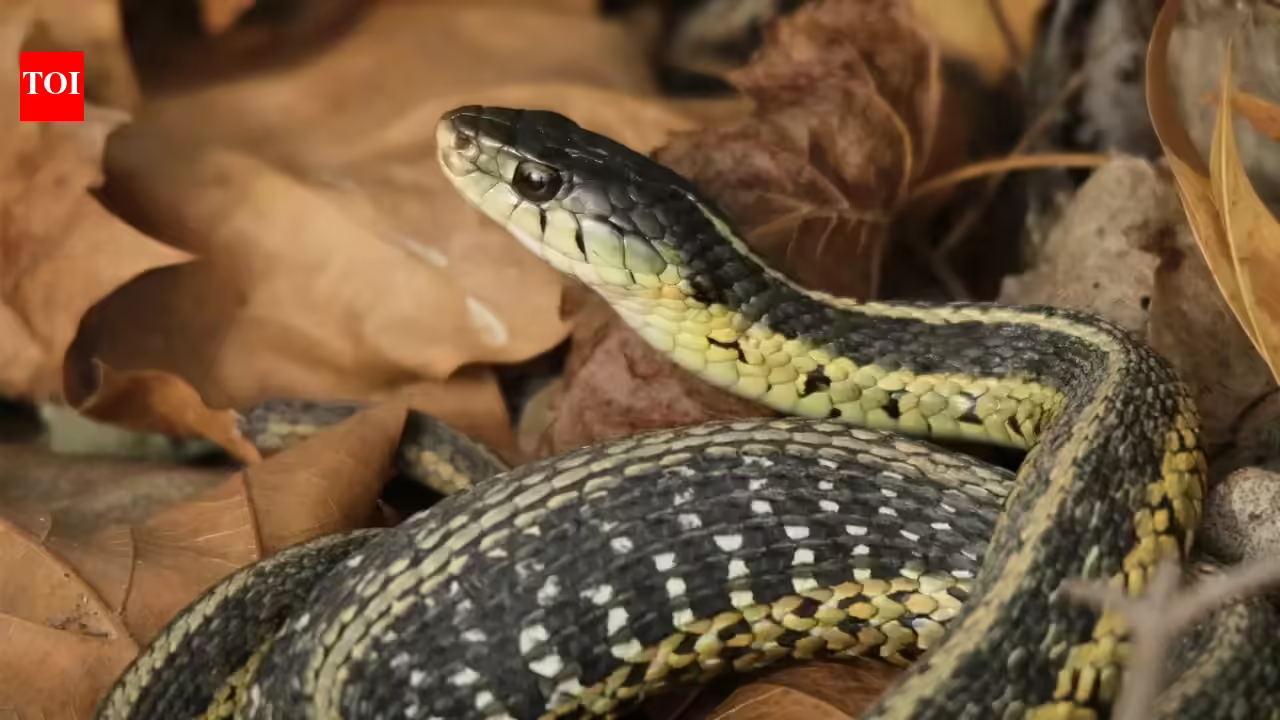
Identifying the garter snake becomes easy through the presence of the stripes. Most types of garter snakes exhibit three prominent stripes that cover their entire bodies. These stripes run in a central strip along the middle part of the back and two on each side of their bodies. The stripe color ranges from yellow, greenish, white, or light brown colors that stand out prominently from the overall dark body color.
Body color and pattern
Garter snakes can be seen in a range of colors such as black, brown, olive, gray, and greenish. Many have checkerboard marks or red stripes between the other stripes. Garter snakes may appear bright in their patterns, but there are some species that tend to look dull or without any stripes at all.
Size and shape
As for the body size, the garter snakes are much slimmer and lighter than other snakes. Most of the garter snakes measure up to 2 to 4 feet long and their bodies are rather long while their heads are smaller and somewhat narrower than the rest of the body parts. Furthermore, unlike most venomous snakes, the head is not large and not shaped like a triangle.
Eyes and scales
The typical feature about the eyes of the garter snakes is that the pupil is round-shaped while the scales are keeled, meaning that there is a ridge-like texture of the scales. Furthermore, the tongue of these snakes has black tips, while the remainder of it is colored red.
behavior
They are quite harmless creatures that will never attack if approached by a person. Instead, the garter snakes tend to escape when bothered, although sometimes, in order to protect themselves, they flatten their bodies or release a bad-smelling musk. Garter snakes are diurnal, thus one can see them sunbathing on the stones or grassy areas.
Habitat
These snakes prefer gardens, grassy meadows, forests, swamps, and regions close to ponds or streams. Moisture is preferred since this type of snakes feed mostly on frogs, earthworms, insects, slugs, and tiny fish. These snakes are usually spotted in the backyard garden or close to water sources during warmer weather periods.
Garter snake vs. ribbon snake
Since garter snakes and ribbon snakes share the same striping characteristic, one should learn to distinguish these species from one another. Ribbon snakes look slenderer and more fragile. In addition, they have a brighter coloration and clean stripes. Another difference between ribbon snakes and garter snakes consists in the presence of the latter species’ white patch before the eye. Also, ribbon snakes have higher position of side stripes.Despite the fact that the garter snakes are harmless, do not touch any wild snake unless you know for sure that it does not pose any threat to you. Some harmless snakes may mimic the appearance of venomous ones, which makes observing them from a safe distance much better.Disclaimer: Snake appearances can vary depending on the species and region. Avoid touching or handling any wild snake unless identified by an expert, as some nonvenomous snakes may resemble venomous ones.