




Gengashree Nidhiban, 30, a BTech in information technology from the College of Engineering, Anna University, Chennai, did her internship at Qualcomm in Bengaluru, before taking up a full-time job, helping companies automate tasks using AI. Sathyashree A, 30, BSc in agriculture from Annamalai University, Chidambaram, Cuddalore, went through an intensive AI training on the job and is now working on advanced driver assistance systems (ADAS) for autonomous vehicles for a Europe-based automaker. Her colleague Harini M, BE in agriculture from Muthayammal College of Engineering, Rasipuram, also underwent AI training and is helping ensure that auto-checkout stores at global retail outlets work without a hitch.
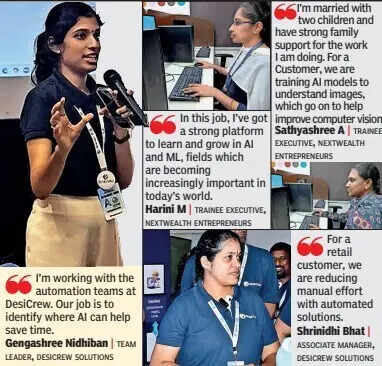
Gengashree, Harini, Sathyashree, Shrinidhi
None of them work out of any of the big poster-cities of hi-tech work, Bengaluru, Gurugram or Hyderabad. Gengashree works from Virudhunagar, about an hour’s drive from Madurai in Tamil Nadu, for DesiCrew, a BPO firm that focuses on remote centres. Sathyashree and Harini work in Mallasamudram and Salem respectively, for NextWealth Entrepreneurs, another similar BPO.From support centers to key unitsFor years, remote BPOs were seen as low-cost support units, doing basic data entry or back-office work for large urban centres. That is changing. As AI automates routine work in big city BPOs, smaller centers in India’s hinterland are finding a new role: enabling AI itself. JK Manivannan, CEO of DesiCrew Solutions, says Covid opened up the “work-from-anywhere” model, while AI created a level playing field for all.
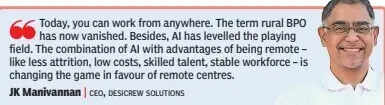
JK Manivannan
The remote talent today annotates data, validates AI models, works on computer vision, trains language systems, processes voice datasets, tests AI outputs and helps companies turn automation into real business workflows. Their customers are the likes of Google, Toyota, Pfizer, Disney Hotstar and AT&T.DesiCrew has around 2,000 employees across centers in Karnataka and Tamil Nadu, with project-based work extending to nearly 20 states for language and voice datasets. Around 60% of its business comes from global clients and 40% from Indian customers. About 70% of its workforce is women. NextWealth Entrepreneurs, which started about 13 years ago, has 11 centres, including in Hubballi, Mysuru, Puducherry, Bhilai in Chhattisgarh, and Jaipur and Udaipur in Rajasthan.Sridhar Mitta, chief mentor and founder of NextWealth Entrepreneurs, says AI replaces people, but it also creates new jobs. “We are in the business of doing those new jobs.” Mitta, a tech veteran, was the first employee and CTO of Wipro, before co-founding NextWealth to create a wider social impact and offer opportunities for women in remote areas. Around 60% of employees are women. And nearly 80% of the work is now AI-related. Employees are put through three to four months training on AI fundamentals, vertical-specific domains and customer-specific processes before given assignments.
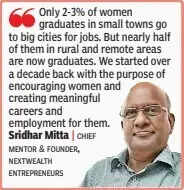
Sridhar Mitta
Sathyashree started at NextWealth in December 2023 with no prior experience. Her first project involved creating training datasets for ADAS systems. The work required annotating images and LiDAR data so autonomous vehicle models could better identify objects and driving conditions. She has since moved into the delivery excellence team as an auditor.Harini, who joined in March 2025, handles cases where the auto-checkout model fails to process transactions.DesiCrew’s Gengashree helps automate client workflows, across insurance and accounting processes. Her team identifies where AI can save time, extract data from PDFs, generate emails, create reports and handle customer tickets faster. One insurance transaction that once took six hours, Manivannan says, was redesigned to close in 30 minutes.Gengashree joined the company initially on part-time work in 2019, bringing up two daughters, managing home and also acquiring new skills via courses on prompt engineering and AWS, Google certifications. She is now a full-time employee, a team leader, and has also participated in AI hackathons to explore how automation can be applied to client processes.Shrinidhi Bhat, an associate manager at DesiCrew based in Kapu, Karnataka, has been with the company for 12 years. A commerce graduate from Mangalore University, Bhat is helping move manual operations for a global retailer to automated ones. She has a six-year-old daughter and her husband is a bank employee.Accent meets AINewer technologies like accent conversion tools are also making it easier for talent in remote areas to engage with global clients. Accent conversion adjusts pronunciation and intonation so the agent is easier to understand. Agents speak as they would and the output is optimized for clarity. Vimal Nair, chief growth officer in Bengaluru-based voice AI solutions company Krisp, says accent conversion removes the need for traditional accent training, and allows agents to focus on problem solving instead of worrying about their accents.Accent conversion, along with traditional cost advantages, is turning the tide in favor of remote centres. Mitta says costs are around 50% lower than in large cities, while attrition is about 10% annually, compared with roughly 50% in urban BPO centres.
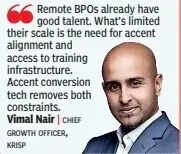
Vimal Nair
A recent Netflix series pointed to centers in India handling data annotation for pornographic content, impacting small-town households. However, Manivannan says they don’t do such work. “And I believe India is not tuned to handle such tasks. If it happens, it’s below the radar, in small fly-by-night operations,” he says.The future is no longer about being a cheaper extension of a city centre. It is about being closer to distributed talent, languages, dialects and stable workforces, solving for the world.NextWealth plans to double its headcount to 10,000 in the next few years, with more AI-related work. DesiCrew is expanding its capabilities in data, automation and AI.