


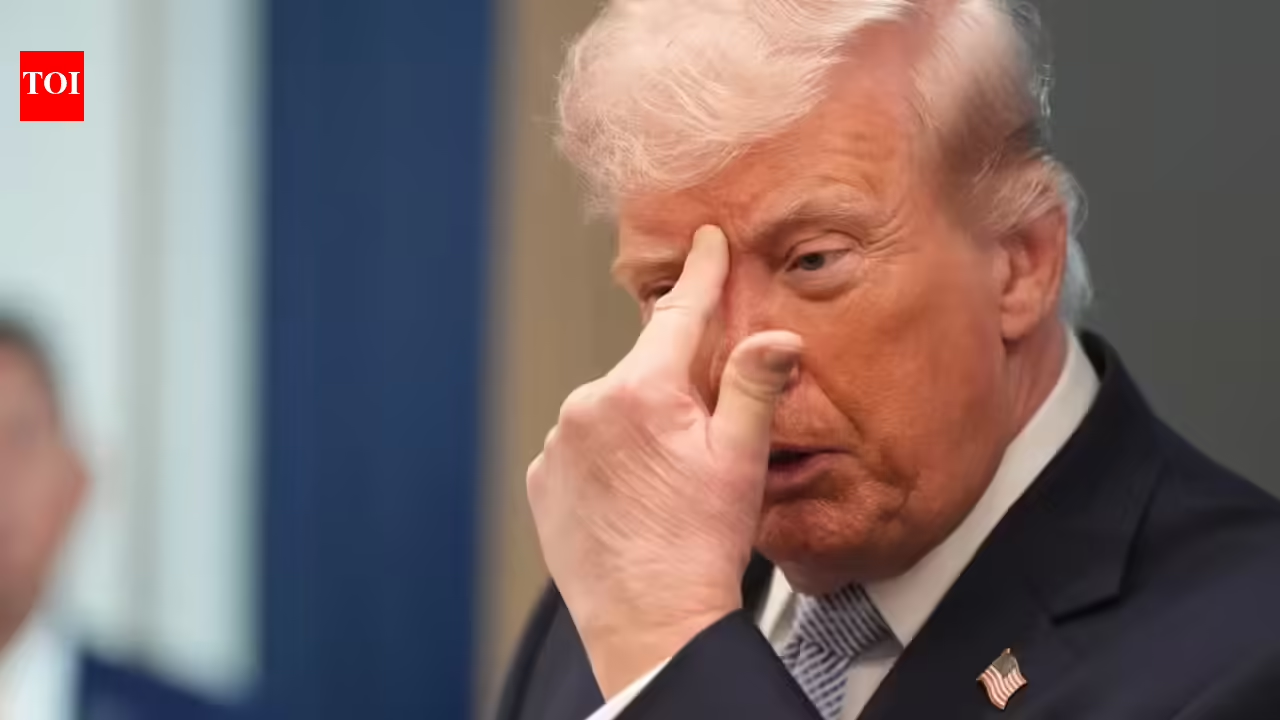
Donald Trump is the first WWE Hall of Famer to make his way to the White House which means that he’s probably familiar with the concept of heels. For those unversed in WWE lore, the heel is an important part of professional wrestling where a supposedly good star turns evil. It’s all part of a script obviously, but even the most hardcore fans were shocked when people’s favorites like The Rock or Stone Cold Steve Austin suddenly turned heel. And now Trump has to deal with heels within his own MAGA ecosystem as Tucker Carlson, Candace Owens, Megyn Kelly, and Alex Jones have broken ranks and gone hammer-and-tongues after the MAGA messiah over the Iran war.For nearly a decade, Donald Trump held together a coalition that should not have worked. It was less a political formation and more a carefully managed contradiction, bringing together voters exhausted by America’s endless wars with others who believed the country had grown too hesitant to use its power. Trump did not resolve that contradiction. He performed it. He could sound like a sceptic of foreign interventions and a champion of overwhelming force, often within the same speech, and his supporters would hear not inconsistency but adaptability.The Iran moment has disrupted that performance. What once passed as flexibility has begun to look like strain, and what was earlier absorbed as part of Trump’s instinctive style is now being read, even by his own allies, as something that demands a choice.
The Big Picture
The tension within MAGA has always been latent rather than absent. On one side sits a deep suspicion of foreign entanglements, shaped by the memory of Iraq and Afghanistan, where intervention promised clarity and delivered confusion. On the other sits an equally strong belief that American power must be asserted, not withheld, particularly when confronting adversaries like Iran.Trump’s political instinct lay in allowing both impulses to coexist without forcing resolution. His rhetoric could accommodate both restraint and aggression, often within the same frame, allowing supporters to see in him a reflection of their own priorities. That arrangement worked as long as the contradiction remained theoretical. It is no longer theoretical.
driving the news
What has triggered the rupture is not simply the geopolitical situation, but the fact that dissent has come from within the system that sustained Trump. Tucker Carlson, Candace Owens, Megyn Kelly and Alex Jones are not peripheral figures. They are part of the ecosystem that translated Trumpism into a daily habit. They shaped its language, amplified its instincts, and reinforced its worldview. Their break is not a disagreement at the margins. It is a fracture at the core. Trump’s decision to respond publicly transformed that fracture into a visible contest over ownership. This is no longer a question of policy alignment. It is a struggle over who gets to define what MAGA is.
What Trump actually said
Trump’s response is revealing in its construction. He described his critics as having “low IQs”, said “they don’t have what it takes, and they never did”, and claimed they had been “thrown off Television” and were no longer relevant because “nobody cares about them”.He labeled them “NUT JOBS” and “TROUBLEMAKERS”, accused them of chasing “cheap publicity”, and remarked that he does not take their calls because he is “too busy on World and Country Affairs”.The statement culminated in a redefinition of the movement itself. “MAGA is about WINNING and STRENGTH… MAGA is about MAKING AMERICA GREAT AGAIN… these people have no idea how to do that, BUT I DO.”It reads less like a rebuttal than a declaration.
What that means for MAGA
What stands out is not what Trump addresses, but what he avoids. There is no engagement with the substance of the criticism. There is no attempt to reconcile competing interpretations of “America First”. Instead, the focus is on disqualifying the critics themselves.In doing so, Trump alters the terms of the conversation. The question is no longer whether his position is correct. It becomes whether those questioning him have the legitimacy to do so.This shift narrows the movement’s internal space. MAGA, which once functioned as a coalition capable of containing contradiction, begins to resemble a defined boundary. Inclusion depends less on shared ideas and more on alignment with Trump’s position.The movement does not resolve its tensions. It absorbs them by excluding one side.
The Groypers problem—the rebellion to the right
If the current rupture feels like a civil war, it is because the ground beneath MAGA has already been shifting.On the fringes of the movement, a younger, more radical cohort has been organizing for years. Known as Groypers, followers of Nick Fuentes, they represent a version of the right that sees Trump not as a culmination, but as a compromise.What defines them is not just ideology, but impatience. They view the Trump era not as a revolution, but as an incomplete one, a moment that promised transformation but settled for performance. In their telling, MAGA never went far enough.Within this worldview, the Iran moment is not surprising. It is predictable. It confirms a long-held suspicion that Trump, when tested, will revert to the same patterns he once criticized. The war becomes less a deviation and more a revelation.The movement itself operates in a strange space between irony and conviction, blending meme culture with political radicalism, often making it difficult to separate performance from belief. Yet beneath the aesthetics lies a coherent dissatisfaction with the existing conservative order, including Trump.What makes them consequential is that they are no longer marginal. Among younger conservatives, particularly those shaped by online spaces, they represent a growing current that sees even MAGA as insufficiently radical.In that sense, the present rupture is not just a split within Trump’s coalition. It is pressure from a generation that believes the movement has already failed its own promise.
What the critics have said
The responses from Trump’s critics reflect this unease. Candace Owens’s remark that “it may be time to put Grandpa up in a home” moves beyond policy disagreement into rejection. Alex Jones’s observation that Trump has “totally changed the man he once was” introduces a narrative of loss. Megyn Kelly’s description of the rhetoric as “completely irresponsible and disgusting” signals discomfort with tone and judgment. Tucker Carlson’s warnings about escalation frame the issue as a departure from what “America First” was meant to represent.Taken together, these responses suggest that the disagreement is not about a single decision, but about the direction of the movement itself.
Why are they actually fighting?
This is not a fight about Iran. It is a fight about definition. For years, MAGA functioned without a fixed doctrinal core, allowing different instincts to coexist under a shared identity. That flexibility allowed it to grow, but it also postponed the need for clarity. Moments of consequence force that clarity. The present moment is one such instance.
What this reveals about MAGA
MAGA’s strength has always been its elasticity. It could mean different things to different people while retaining a shared emotional core. That elasticity is now under strain. When a movement built on contradiction is forced to make a choice, it does not simply adapt. It reveals what it cannot reconcile. Trump’s instinct is not to reconcile competing positions but to redefine the boundaries of the movement. Critics are not engaged. They are reclassified. The debate is not resolved. It is reframed. This approach has maintained cohesion in the past, but it also transforms the nature of the movement, making it more dependent on alignment than argument.
What happens next?
Trump will likely retain the loyalty that has sustained him. That remains the movement’s center of gravity. What has changed is the ecosystem around him. It is no longer uniformly aligned, and it is no longer content to remain so. For years, MAGA resembled professional wrestling, a performance where roles were understood even when not explicitly stated, and where the audience participated in sustaining the illusion. What is unfolding now feels different. The roles are less certain. The alignments less stable. The script is less reliable. And like any WWE pay-per-view, the spectacle has begun to slip into something else entirely, where the fight continues, the crowd watches, and nobody is entirely sure whether what they are seeing is still part of the show.