


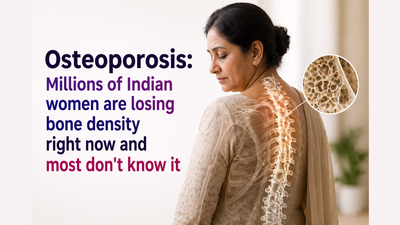
There’s a particular cruelty to osteoporosis. It doesn’t hurt. It doesn’t show up on your face or slow your walk or give you any real warning at all. It just quietly hollows out your bones over years, sometimes decades, until one ordinary moment, a small stumble, a minor fall, ends in a fracture that changes everything. By that point, according to Dr. Bharat Mody, Director and Chief Joint Replacement Surgeon at Welcare Hospital, significant bone density may already be gone.“Most people do not realize they have osteoporosis until a fracture occurs,” says Dr. Mody. “By the time the condition is diagnosed, significant bone density may already have been lost.” That’s the nature of what he calls a silent disease and in India, it’s playing out at a scale that the healthcare system is only beginning to fully reckon with.
The numbers are hard to ignore
Studies suggest that nearly one in three women over the age of 50 in India will experience an osteoporotic fracture at some point in their lives. That’s not a marginal risk. That’s a near-certain outcome for a massive portion of the female population, in a country where both life expectancy and the elderly population are rising steadily. As Dr. Mody puts it, osteoporosis is “not only a medical issue but also an emerging public health challenge.”The reasons women are disproportionately affected come down to biology, specifically to estrogen. After menopause, estrogen levels drop significantly, and estrogen is the hormone that regulates the balance between bone formation and bone breakdown. When it falls, bone resorption begins to outpace bone formation. The skeleton weakens gradually, silently, and the process can go on for years before any symptoms surface. So by the time a 65-year-old woman fractures her hip stepping off a curb, the damage started somewhere in her early fifties.
why hip fractures are especially dangerous
Not all fractures are equal. The spine and wrist are commonly affected in osteoporosis, and those injuries are serious enough. But hip fractures carry a different kind of weight. In older women, they can trigger a cascade — prolonged immobility, loss of independence, surgical intervention, lengthy rehabilitation. And research has shown something particularly sobering: hip fractures are associated with significantly increased mortality within the first year following injury. We’re not talking about a broken bone that heals and resolves. We’re talking about an event that, for many elderly women, marks a permanent turning point in their health and independence.Dr. Mody is direct about what he sees in practice. “Fractures related to weakened bones are becoming increasingly common among elderly patients. Unfortunately, in many cases the underlying osteoporosis is not diagnosed or treated until after the first fracture occurs.” That’s the pattern that needs to change, and it starts with screening.
The test most women aren’t getting
A DEXA scan, which measures Bone Mineral Density, is the gold standard for diagnosing osteoporosis. It’s non-invasive, relatively quick, and gives doctors a clear picture of where a patient’s bone health actually stands. Dr. Mody recommends that women begin screening around the time of menopause, with earlier evaluation for those carrying additional risk factors like family history of osteoporosis, low body weight, long-term steroid use, or nutritional deficiencies.There’s also a clinical tool called the FRAX model, which combines bone density results with individual risk factors to estimate the probability of a fracture over the next ten years. It allows doctors to identify high-risk patients and begin treatment before the first fracture, which is precisely where intervention does the most good. But none of it works if women aren’t getting screened in the first place.
What can actually be done
Treatment has advanced considerably. Bisphosphonates remain widely used to slow bone loss. Newer therapies, including denosumab and anabolic agents like teriparatide, have shown strong results in improving bone density in more vulnerable patients. These are not experimental options. They’re established, available, and effective when started early enough.But medication is only part of the picture. Calcium and Vitamin D intake are foundational, and both are chronically insufficient in large parts of the Indian population. Weight-bearing exercise, walking, resistance training, yoga, helps maintain bone strength and, crucially, improves balance, which directly reduces fall risk. Simple home safety measures matter too. Better lighting, non-slip floors, addressing vision problems. Unglamorous interventions, but the kind that actually prevent the fracture in the first place.“Osteoporosis should not be seen as an inevitable part of aging,” Dr. Modi says. And he’s right. It’s a condition that responds to early attention. The problem isn’t that we lack the tools. It’s that too many women reach their fifties without ever being told that their bones deserve the same preventive care as their heart or their blood pressure. That conversation needs to start earlier and it needs to start now.Medical experts consulted This article includes expert inputs shared with TOI Health by: Dr. Bharat Mody, Director and Chief Joint Replacement Surgeon at Welcare HospitalInputs were used to explain why osteoporosis affects women and how it can be prevented.