



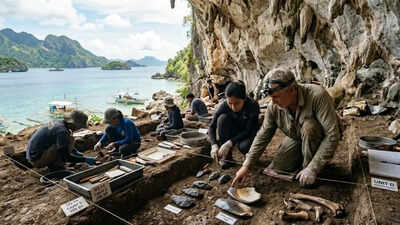
Recent archaeological discoveries have reshaped our understanding of prehistory in Southeast Asia. Early people in the Philippines are now considered to be the pioneers and innovators of sailing, instead of being isolated groups of humans inhabiting these archipelagos. Research based on evidence from Mindoro Island shows that over 40,000 years ago, people were navigating open-ocean corridors; practicing pelagic fishing, and, creating complex and interconnected communities as well as technology around the water. Contrary to what has long been believed about how these Islands were remotely located and reached by accident while adrift at sea. According to Modern Sciences, evidence has been found on the Islands that includes the use of more advanced tool-making methods for shellfish, and evidence of pelagic fish being located far away from land, indicating that people willingly traveled many times between landmasses. As researchers document through mapping these previous interactions between communities throughout the world, there is a realization that one of the main areas where interaction occurred between communities was through sailing and using the waters that are present around the Philippines and building strong networks for trade and cultural exchanges.
Findings showed that humans built island networks across the Philippines
There are indications from Mindoro Archeology Project data that these early societies used caves and rock shelters, within a broader and interdependent system of places that they could be characterized as integrated settlements; and in place of isolated communities, researchers saw there’s been evidence of continuous human activity in these locations for more than 35,000 years, indicating that these places were part of an extensive system of sharing knowledge, materials, and culture among communities across hundreds of miles of water as noted in a study at Ateneo de Manila University.
Evidence of advanced watercraft and deep-sea fishing was found in this study
The fact that there were no land connections to these islands existing during the Ice Age must mean that to reach them required an organized effort at sea. According to the study published at Ateneo de Manila University, the microscopic study of stone tools shows that these early settlers could create ropes and nets from plant fibers to build watercraft and the fishing gear necessary for deep-sea fishing and accessing many of the marine resources available to them, such as tuna and shark found within the archaeological record.
How coastal innovation linked isolated island populations
By leveraging the coastal environment and available resources, early residents of islands were able to demonstrate their adaptability and find solutions to environmental limitations. The creation of an adze (a woodworking tool) from giant clam shells enabled the shaping of wood into paddles, shelters, and components for vessels. The ability to shape wood, through the use of adzes, created and maintained maritime networks which transported both physical and intangible materials over long distances, virtually linking the populations of islands in a way that challenges the traditional paradigm of primitive isolation.