



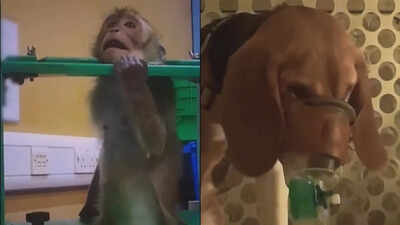
Weight loss jabs have taken the world by storm in the past few years, giving people their magical figures and idealized appearance. However, the jabs that work wonders on human bodies give pain and numerous health issues to animals whose bodies they are tested on.Pictures from laboratories in the United Kingdom where weight loss jabs are being tested have gone viral on the internet, revealing the harsh reality of animal cruelty that goes behind creating medicinal magnums. A lab worker at two weight-loss drug testing plants recently shared some pictures with DailyMailUK adding that he was horrified at the ‘immense distress’ the animals endured.While restrained long-tailed macaques were fed anti-obesity medication into their stomach for testing, other animals including beagles, pigs, rabbits and more faced ‘extreme suffering’ during trials for other drugs before they can be sold in high street chemists.These not only include trials for weight-loss drugs but also everyday medicines such as headache tablets, cholesterol drugs, reflux medications, antihistamines, antibiotics and antidepressants. The worker also revealed that all the animals that survive the tests are killed at the end of the process and their bodies are dissected for further studies.
An informed public debate
The reason for sharing the shocking images was revealed to be an aim of an informed public debate on the use of animal testing. He described being ‘haunted’ by the shrieks and whimpers of animals during the trials which could last for up to 2 years.Numerous netizens took to social media apps to call out the medicinal industry for animal cruelty along with pointing out that the reason for the testing is the human greed for beauty.“The fear, you can see the pure fear in this poor creature’s eyes. This is a glimpse into hell, the hell created by us,” wrote a user on X.“This is disgusting animal abuse. Very few people should even need weight loss jabs,” added another.“Horrible, this is not science, it’s cruelty and abuse,” one claimed. However, as per an animal advocacy group, the ‘extreme suffering’ was extremely rare and the trials are vital for producing life-saving medication and ensuring drugs are safe for human use.
animal testing methods
The tests on animals are used to determine the safety margins for use of the drug, how compounds are moved around the body and the effects of the medication on the organs. The most common method is the ‘oral gavage’ where a rubber tube is pushed down the throats of restrained animals into their stomachs to feed the substance directly into their body. This method is used for long-tailed macaques to test medication for liver diseases and weight-loss drugs and beagles for anti-inflammation drugs.Another method is where masks are strapped to the faces of beagles and monkeys and the trial substance is inhaled by them. For these tests, monkeys are prepared by being restrained in vices around their necks and waists.Mini pigs are used to test medication for ulcers and skin infections by using treatments where eight cuts are taken from the back of the animals and a gel is applied daily. Intravenous tests are also conducted where the animals are restrained and the test compound is injected directly into their bloodstream.The lab worker’s intervention comes after the US Food and Drug Administration (FDA) announced guidance to help drug developers create alternatives to animal testing to trial new products. The American regulator said it wants a shift to ‘human-centric models’ which it said can ‘more reliably, efficiently and ethically predict human drug reactions prior to clinical trials’.In 2025, the FDA even claimed that animals ‘do not’ provide an adequate model of human health and disease. ‘Over 90 per cent of drugs that appear safe and effective in animals do not go on to receive FDA approval in humans, predominantly due to safety and or efficacy issues.’Whatever the aims or the results, the suffering and distress faced by animals during the process are unjustified. Lyn White, director of Animals International, who was approached by the lab worker to help highlight the issue, said: “What this evidence shows is not just isolated procedures but animals enduring weeks and sometimes months of repeated dosing, restraint and confinement. Their suffering and distress are not momentary – it is prolonged and cumulative.“