


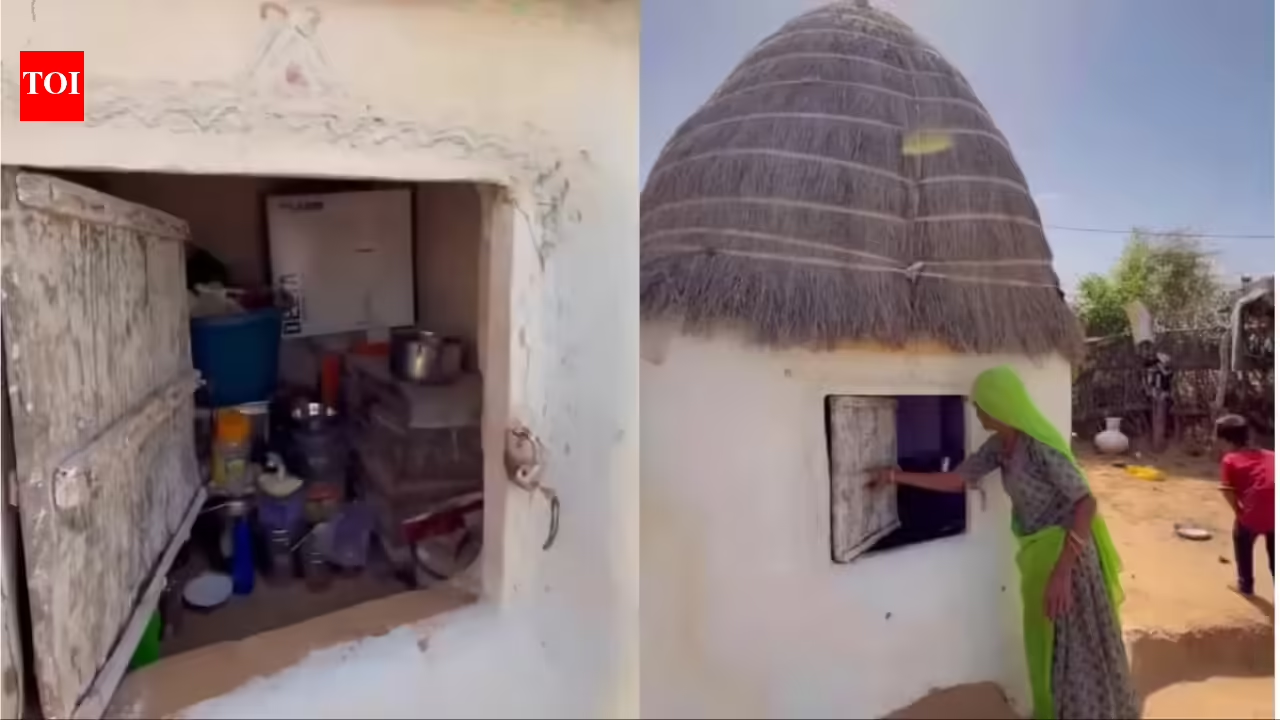
In an era when refrigerators and air conditioners have become our everyday companions and our electricity bills keep on increasing, an old invention of Rajasthan is unknowingly becoming a viral sensation in 2026. Commonly called the “desi fridge”, this age-old cooling technique made of mud, cow dung and grass is winning hearts not only in India but also worldwide. It does what today’s electrical appliances can barely do: preserving the freshness of food during scorching heat without consuming any electricity at all.As temperatures soar past 40°C across India, this forgotten technique is being rediscovered not just as a cultural artifact but as a serious, science-backed solution to sustainable living.
The ancient cooling hack that defies modern technology
This natural system operates by utilizing porous and locally available materials which have the capability of producing a sufficiently strong cooling effect to keep perishables fresh even during the hottest summers. Usually, such a system is composed of clay pots or chambers, sand or organic materials kept wet and natural insulation such as cow dung and grass.These components combined result in a no-energy refrigeration method, which has been in use for a long time in rural parts of India even before the availability of electricity. The fact that it is very simple is only the tip of the iceberg; the main point is that it works extremely well.
The science behind the “Desi Fridge”
The very essence of this technology is a natural and potent process: evaporative cooling. Just as sweating cools us down, the evaporation of water from the porous clay walls of the pot is constantly removing heat, hence lowering the temperature inside.According to a 2026 research paper, Evaporative Cooling and Deposition Patterns of Nanofluid Dropletsthe evaporative cooling effect increases when the heating is intensified. The paper thus demonstrates that evaporative cooling actually works more efficiently at higher temperatures, which is a great reason for clay-based cooling systems to be super effective in hot and dry areas like Rajasthan. A 2026 article published by Springergiving a research context on pot-in-pot cooling systems, revealed that inside a pot-pot cooling system the temperature can be lowered between 8 and 18C. This research points to the fact that clay cooling systems, which are based on traditional principles, can lower the temperature substantially and at the same time increase humidity and thereby can significantly prolong the shelf life of fruits and vegetables, occasionally by weeks.Modern studies confirm that terracotta’s porous structure enables powerful passive cooling, reinforcing why such systems have survived for thousands of years.
Why this 100-year-old system is trends again
The revival of the “desi fridge” is not just about nostalgia, it is about necessity. Given the climate change and rising costs, heatwaves are becoming more frequent, electricity costs are rising and power outages remain common in many regions.This “desi fridge” is a sustainability movement with zero carbon footprint, no reliance on electricity and made from biodegradable, local materials. Even in cities, people are now exploring eco-friendly alternatives to reduce energy consumption, bringing ancient wisdom back into modern homes.However, these solutions have limitations and are most efficient in areas with very warm temperatures and dry atmosphere where there is good wind flow and a low level of moisture in the earth. Still, for large parts of India, they remain a practical and affordable solution.The main reason why Rajasthan’s “desi fridge” is so attractive is that it shares a different philosophy with its function. On the one hand, it embodies Rajasthan’s indigenous knowledge systems. On the other, it is a reminder that non-conventional solutions and innovations exist. As the world is looking for greener choices, this earth-friendly device is a proof that the way for sustainability goes through history. It wasn’t an old-fashioned invention after all but a wise one.