


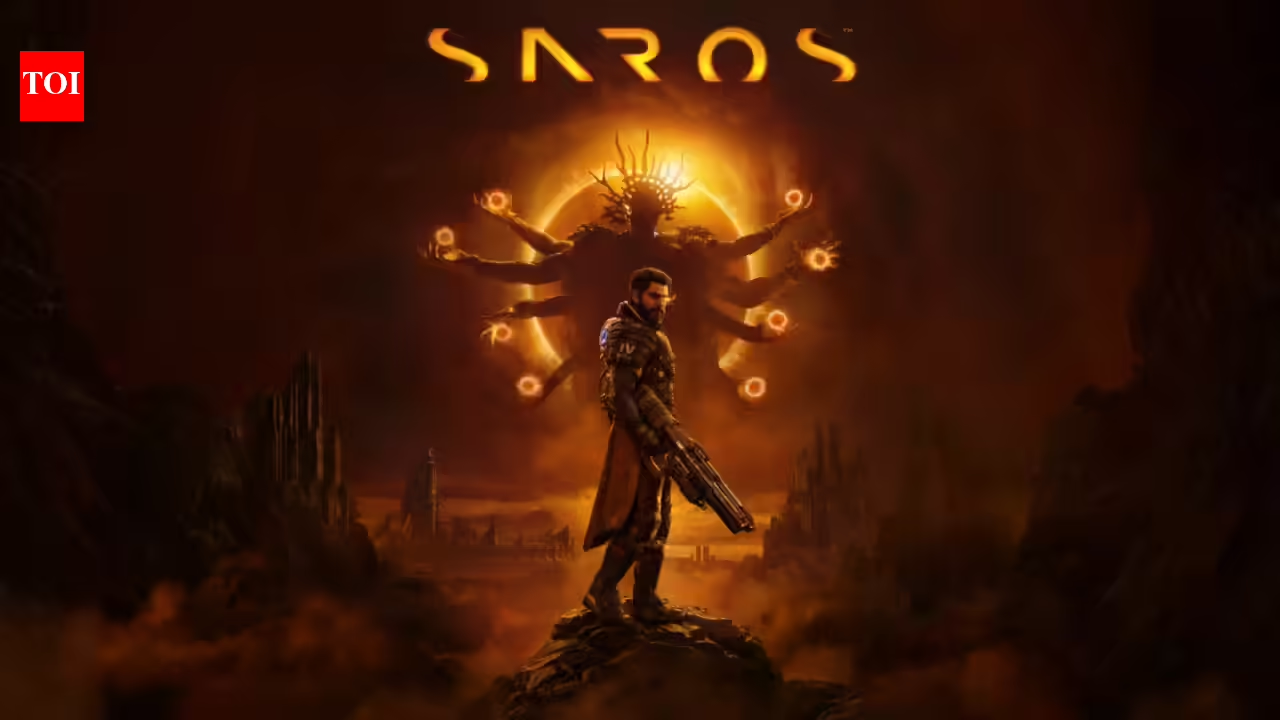
I died in a hallway. Not a glorious last stand—a hallway. Three orange orbs the size of beach balls drifted in from somewhere I wasn’t looking, and Arjun Devraj, my borrowed body for the evening, came apart into a puff of gold particles that drifted up toward a sun that should not be that close. The screen blinked. The camera pulled back. Somewhere in a Finnish studio, a developer is laughing.This is hour twelve of Saros, and I keep thinking I’ve figured it out. I haven’t figured it out. Housemarque’s new PS5 exclusive wants you to lose, then come back and lose better, then come back and almost win, then come back and, well, you know how this goes. If you played Returnal, you really know how this goes. Saros is the studio’s loose, ambitious follow-up, sharper in places, softer in others, and so far it’s the most fun I’ve had wasting deaths in a long time.
Welcome to the planet that hates you
Carcosa is the kind of alien world that doesn’t introduce itself. You just land there and start dying.You play Arjun, a Soltari Enforcer (Soltari being the kind of mega-corp that has a slogan, a logo, and absolutely nothing in the way of a moral compass) dropped onto a planet where three previous expeditions have gone radio silent. The official mission is to find them. The unofficial mission is to figure out what is wrong with the place, because something is very, very wrong. Statues writhe. Cables snake into the ground like nerves. White marble walls hold up sculptures of arms clawing out of stone, faces frozen mid-scream. There is a sun overhead that is not behaving like a sun, and an eclipse that keeps showing up uninvited.The vibe is somewhere between Alien, Annihilation, and a fever dream you’d have after eating bad biryani. It absolutely works. Carcosa shifts a little every time Arjun dies and respawns, and the team at Housemarque has clearly studied how light hits skin and chrome and weird alien blood. I caught myself just standing in a corridor one evening because the way the eclipse light was fanning across a row of biomechanical pillars looked like someone had spilled honey across a CT scan.You go out, you fight, you die, you come back to a hub area called The Passage. Your crewmates are still here, mostly. They’re tired. They have that thousand-yard stare. One of them is leaning on a wall in a way that suggests she is not okay. Nobody says much. You head back out.
Dodge in color, shoot in stereo
Pretty quickly, your eyes start sorting the chaos by color before your brain catches up.The combat is what Housemarque is calling “bullet ballet” and the marketing department is right for once. Enemies don’t fire bullets so much as paint the room with them. Blue orbs, yellow orbs, red orbs, lasers that arrive faster than your reaction time, and the occasional volleyball-sized projectile that comes at you so slowly you can hear it. Each color means something. Blue, you can absorb with your shield, which charges your Power Weapon, the big-deal special attack you save for when things get out of hand. Yellow, you dodge through, and if you don’t, it builds Corruption that nibbles at your max health. Red, you either get out of the way or, if you’re feeling brave, parry it back. I can parry maybe one in three. Most of mine, I just dodge.The shield is the new thing here. Returnal didn’t have one. Adding it changes the whole rhythm of the game. You’re not constantly running away anymore—you’re picking moments to plant yourself, take the hit on purpose, and turn it into ammo. The first time I did this on a mini-boss called the Sunflayer—a furious thing that fires sweeping arcs of blue—I felt like I’d cracked a code. Soak the orbs, charge up, blast it in the chest with a rocket-thing, dodge, repeat. It’s a closed loop and it’s beautiful when you’re on.The DualSense work is, again, ridiculous. Half-pull the left trigger and you switch to a weapon’s alt-fire. Pull all the way and you fire your Power Weapon. You can feel the click in the trigger when you cross the threshold, and after a few hours your fingers start doing it without your brain getting involved. I’d be playing while half-thinking about an email and would suddenly be unloading a charged shot into something’s face without remembering deciding to.The weapons are wild. Hand cannons that ricochet bullets off walls. A Smart Rifle whose bullets curve toward enemies like they have a grudge. Crossbows that fire bolts of pure energy. A pistol with active-reload that you have to time, like a tiny rhythm game in the middle of a firefight. I’ve been favoring the Smart Rifle because honestly I am a casual gamer who would like to focus on not dying, and homing bullets help. Some weapons turn off the auto-aim entirely for more damage. Hardcore types will love them. I respect them. I will not be using them.
Death has a punch card
Most roguelikes punish you for dying. Saros sort of pays you for it.Returnal, bless it, was punishing in a way that turned a lot of players off. You died, you lost almost everything, and you started over. Saros has decided to be slightly nicer about this. You still lose your run, your weapons, your temporary buffs. But the Lucenite—the gold-colored currency you’ve been hoovering up off corpses—stays with you. You take it back to The Passage and spend it on permanent upgrades. More armour. More shield. Better starting kit. Bigger Lucnite collection radius. The skill tree is called the Armor Matrix and it is large.This means every run is doing something, even the bad ones. I had a run last week that lasted maybe nine minutes before I walked into an ambush and got reduced to powder. Annoying. But I came back to base with enough Luceneite to buy two new nodes, including one that lets me start every run with a key, which means I can crack open locked containers from the jump. Worth it. Sort of.The other big tweak is run length. Saros runs are roughly 30 minutes if you’re moving, sometimes shorter if you’re confident. You can also fast-travel from The Passage straight to any biome you’ve already unlocked, which means if a specific boss is kicking you around, you don’t have to grind through everything that came before. You can also do the long route, building up a stack of buffs before you reach the fight, if you want a fairer shot. It’s flexible in a way that respects your time. As someone who often plays games in 45-minute windows between assignments, I appreciate this enormously.There are also Carcosian Modifiers, which I’ve only just unlocked. You can stack buffs on yourself before a run, more damage, more health, but you have to balance them with debuffs, like reduced Lucenite drops or harder enemies. It’s a clever system. I’ve been ignoring it because I’m barely surviving as it is.
Arjun is in a whole mood
Arjun does not have a witty one-liner ready. Arjun is not, broadly, having a good time.If you watched Midnight Mass or The Fall of the House of Usher, you know Kohli has range. Here he gives Arjun a kind of clenched, slow-burning fury that you don’t usually get in PlayStation protagonists. He doesn’t quip. He doesn’t crack wise after kills. He’s pissed off and tired and looking for someone, and Kohli plays it like a man who hasn’t slept in a week and isn’t planning to. There’s a moment early on where he says a single word in response to a crewmate’s question and the room temperature drops. I rewound the cutscene to hear it again.I won’t get into the story, partly because Saros is clearly playing a longer game than it’s showing. What I’ll say is the audio logs are the good stuff. They’re scattered across runs, picked up randomly, and they fill in the gaps about who was here before and what happened to them. Some are mission reports. Some are diary entries. A few are just people losing their minds in real time. Housemarque has always been good at this, building a mood out of debris, and Saros leans into it harder than Returnal did.There’s a recurring reference to something called The King in Yellow. I had to look it up. Turns out it’s an 1895 short story collection by Robert W. Chambers that Lovecraft borrowed from, and it’s been borrowed from since by everyone from True Detective to Mass Effect. Saros pulls names and themes from it openly. You don’t need to have read it to follow what’s happening. But the references are everywhere if you start looking.
So, twelve hours in
Saros is not a perfect game. The early going is a bit of a slog before the systems open up. The supporting cast feels like a row of people queuing to lose their minds. A couple of weapons are dead weight, and the camera occasionally drifts off to admire the scenery while something is eating you.But, when it clicks. When you’re mid-arena, screen full of orbs, dashing through yellow, eating blue, parrying red, and your Power Weapon is fully charged and you let it rip and the entire enemy formation just—evaporates—it’s the best thing on PS5 right now. Saros isn’t reinventing what Housemarque does. It’s tightening it, opening it up, and letting more people in. The studio has spent years on this loop and it shows in every animation, every haptic buzz, every weirdly satisfying click of the half-trigger.My thumbs hurt. I’m going back in.