

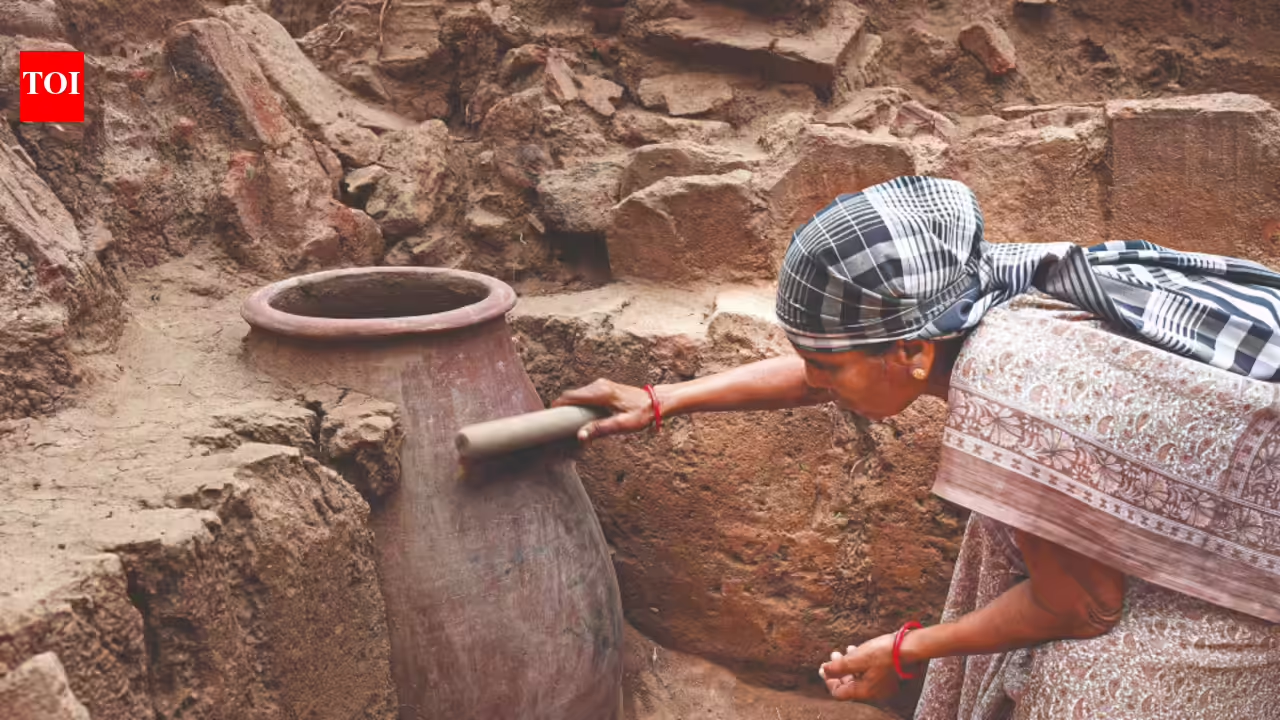
With excavations such as the one at Keeladi revealing an urban civilization in Tamil Nadu dating back more than 2,000 years, debates around looking at Indian history from a South India perspective grow more intense. Now, the publishing of the Comparative Etymological Dictionary of Tamil and Indo-European Languages, a 12-volume lexicography project, throws the spotlight on linguistics and a quest to prove the antiquity of the Tamil language. Word by ancient word.“Many will agree that Tamil is one of the oldest languages in the world,” says G Arasentiran, chief editor of the Etymological Dictionary of Tamil and Indo-European Project (EDITP) published by Tamil Nadu Textbook and Educational Services Corporation under the education department. “We are tracing the comprehensive history of Tamil and linking it with Indo-European languages.” Never before has such an attempt been made at this scale and scope, he says. “Tamil has several words that are root forms of several expressions found in the Indo-European family of languages.”Four volumes of the dictionary have already been published, with the latest launched in Chennai recently. Each volume runs into more than 1,500 pages. EDTIP, says Arasentiran, aims to analyze 300 of the 461 root words identified by English etymologist Walter William Skeat in his 1888 work, An Etymological Dictionary of the English Language. Launched in March 2022, the project has a 21-member team compiling Tamil root words and tracing their derivatives across Indo-European languages. Of the 300 words, 79 have been examined so far in the first four volumes. The EDTIP team is working on the remaining eight volumes, which it says will be done in three years. The project offers examples of how Tamil could be the source for Indo-European languages. For example, the dictionary, explains the etymology of the Tamil word ‘poru’, meaning ‘to bear’ or ‘to tolerate’. In English, says the dictionary, this appears as ‘bear’ or ‘bore’; in Old English as ‘bearn’ (child); in Gothic as ‘bair-an’; in Old High German as ‘beran’; in Greek as ‘pher-ō’; in Latin as ‘fero’; and in Sanskrit as ‘bhri’ (bhar). Arasentiran says these similarities show linguistic connections.It is generally accepted by linguists that the root for ‘bear’ is ‘bar’. According to 19th century Indo-European linguist Max Müller, the root ‘bar’, however, is not an English root and existed long before, in Latin, Greek, Celtic, Slavonic, Zend and Sanskrit, all part of the Aryan family of speech. However, Müller’s work is cited to establish the antiquity of the root itself, not its link to Tamil.Nineteenth century English missionary and linguist Robert Caldwell, who worked extensively on Dravidian languages, traces ‘bar’ to the Tamil word ‘poru’. Tamil linguist Devaneya Pavanar, however, says ‘poru’ evolved from the word ‘pul’ (aggregation), changing over time through forms such as pul, pol, por, poru and poṟu. “Thus, one arrives at the fact that all the Aryan words denoting ‘bearing’ have originated from Tamil, which is the world’s first language, the mother of Dravidian languages, and the source of Aryan languages,” writes Pavanar in his book ‘Talaimaitamil’ published in the 1970s.“All these words may trace back to ‘poru’. But scholars are not always clear on how ‘poru’ itself was formed in Tamil. That is why the term ‘Proto-Dravidian’ is used rather than ‘Proto-Tamil’,” says Arasentiran. “If it were termed ‘Proto-Tamil’, speakers of other Dravidian languages such as Kannada, Malayalam and Telugu may not accept Tamil as the source and instead see it as a sister language.”Another aspect discussed in the project is the proposed link between Tamil and the languages of Australian aboriginal communities. According to Indologist Stephan Hillyer Levitt’s research, the language of the aboriginal communities, believed to have been spoken for 40,000 years, may have connections to Tamil. “By this he also accepts the Dravidian Ascent Theory (Tamils moved from south to north),” says Arasentiran. In its 2026 poll promises, DMK said it would form a panel to study linguistic and cultural links between Tamil and Australian aborigines. Earlier etymological works have largely stayed within defined linguistic boundaries. ‘Senthamil Sorpirappiyal’ focused exclusively on Tamil, while ‘A Dravidian Etymological Dictionary’ by T Burrow and MB Emeneau studied vocabulary across Dravidian languages. EDTIP is the first to systematically trace links between Tamil and Indo-European languages.“By asserting the antiquity of the Tamil language, we are not trying to divide people,” says Arasentiran. “Our aim is to show that all people are connected, that the world is one family.”