


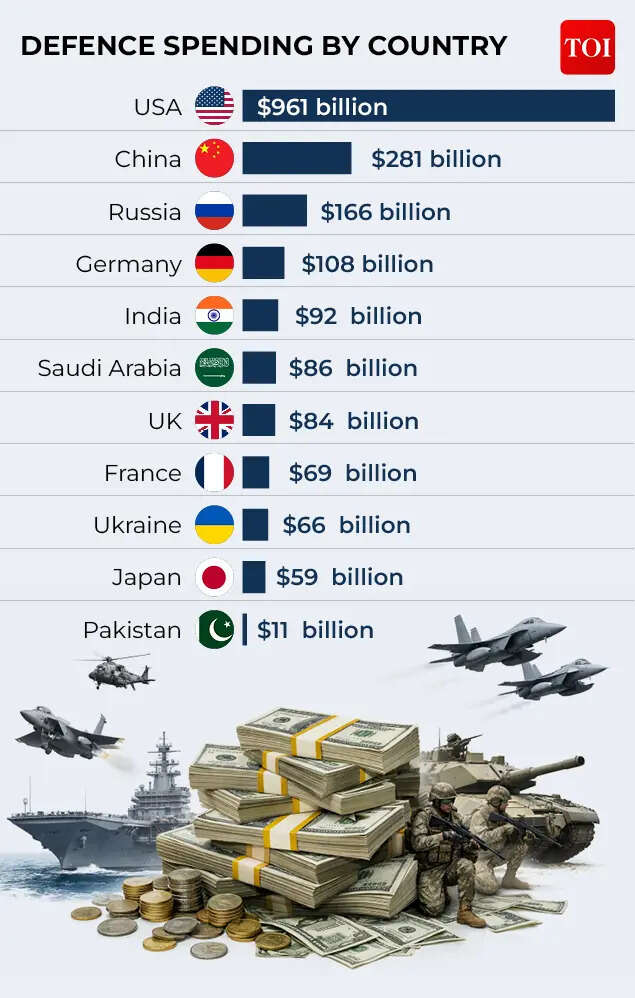
Defense budgets often make headlines for the sheer scale of spending, typically running into billions of dollars. In the last financial year, governments across the world spent over $2.88 billion on defence, with a handful of countries accounting for the lion’s share.This year too, the United States remains far ahead, with a defense budget of $961 billion. The Pentagon has also sought an additional $200 billion due to the ongoing conflict in the Persian Gulf.China is also steadily increasing its military spending. This year, the Chinese Communist Party has allocated the equivalent of $281 billion, marking an increase of over 7%. China is followed by Russia at $166 billion, Germany at $108 billion and India at $94 billion.Defense budgets worldwide are on the rise. Lessons from conflicts in Ukraine and West Asia are pushing countries to spend more, as they adapt to a new, increasingly computerized way of fighting wars. With Europe rearming and many Nato members pledging to raise defense spending to 5% of GDP, global military expenditure is expected to increase further over the next decade.The United States alone is working toward increasing its defense budget to $1.5 trillion in the next financial year, according to the International Institute of Strategic Studies (IISS). America’s current spending already exceeds the combined defense budgets of the next eight countries. The chart below shows how defense spending relates to overall economic strength.
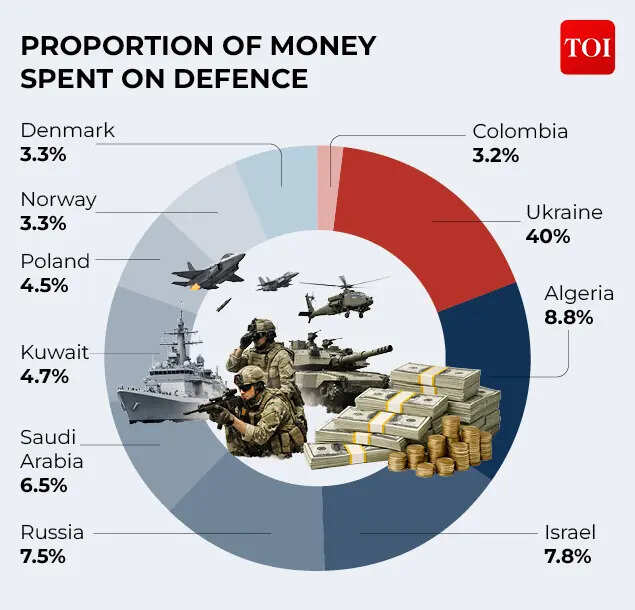
Another way to understand defense spending is by looking at how seriously countries prioritize security, measured as a share of their GDP.According to data from the Stockholm International Peace Research Institute (SIPRI), war-torn Ukraine tops the list, allocating 40% of its GDP to defence. Israel follows at 7.8% and Russia at 7.5%.The United States ranks 11th, spending 3.1% of its GDP on defense. Pakistan, at 2.9%, ranks ahead of India, which stands at 30th position with 1.9% of its GDP allocated to defence.
A third way to interpret defense spending is through per capita expenditure; how much each country spends per person.In this measure, smaller countries often outpace larger ones. Israel tops the list at $4,153, followed by Qatar at $3,935, according to SIPRI data for 2025. The global average stands at $352.
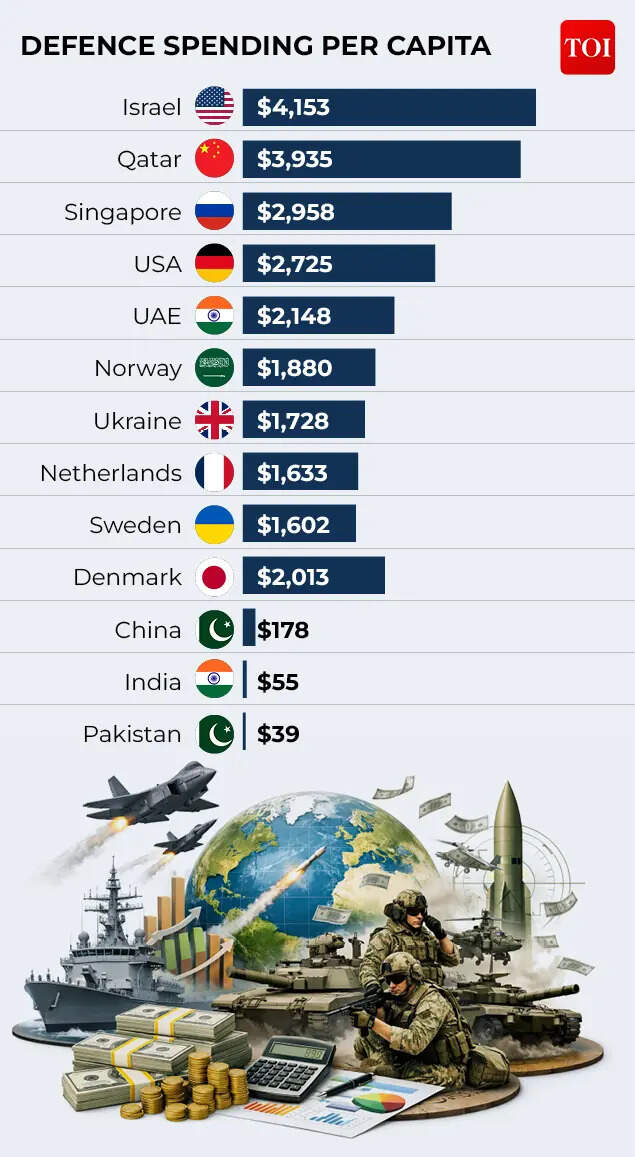
These figures show that defense budgets are more than just headline numbers. They reveal how nations project military power based on economic strength, how high defense ranks as a national priority, and how the financial burden of security is distributed across citizens.