


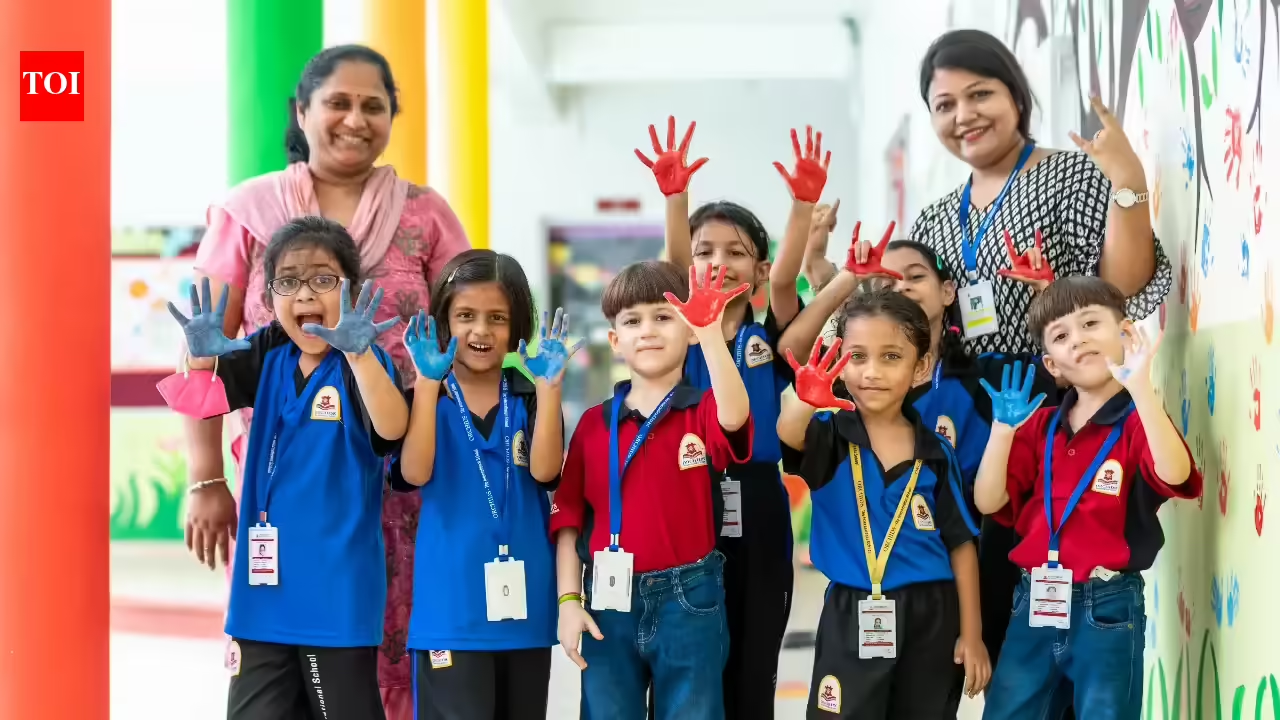
Here’s something that might change how you think about childhood. In a 2025 study, researchers asked over 300 children aged 4 to 7 a simple question: what genuinely makes you happy? Not what you want, not what impresses your friends, just what makes you happy. The answers were strikingly simple: imaginative play, time with friends, and being outdoors. No mention of gadgets or structured programs. Just the most instinctive version of childhood. And yet, that version is quietly disappearing.The 2025 Common Sense Media Census² found that children aged 5 to 8 now spend an average of three and a half hours a day on screens, with gaming time alone rising by 65% in just four years. At the same time, a review of multiple studies published between 2020 and 2025 points to a parallel shift: as unstructured play declines, social and emotional development begins to take a hit.This makes the summer break more important than ever. It is the largest uninterrupted window of time children get all year. The real question is: what do we do with it?The gap nobody’s measuringEvery year, parents worry about thesummer slide‘, the dip in academic skills during long breaks. It is real, widely studied, and often addressed through classes and structured learning. But alongside it, another shift is taking place.Call it the imagination gap. Or the social gap. It shows up not in grades, but in quieter ways: a child’s ability to hold a conversation, resolve a disagreement, or sit comfortably with an unstructured afternoon. Research in the American Journal of Play found that children have steadily lost significant hours of free time over the decades³, with the sharpest decline in unstructured play and everyday conversation. The trend has only deepened since.Most recent longitudinal research⁴ suggests that higher early childhood screen exposure is linked to measurable differences in language development, peer interaction, and early learning skills. Not catastrophically. Not in ways a report card would immediately flag. But gradually. And cumulatively.Teachers often notice it when children return to school. Those who have had time to read, play in groups, and engage in long, open-ended conversations tend to come back more curious, more expressive, and better at listening. What children need, and what gets in the wayThe instinct to fill a child’s summer is deeply parental and entirely understandable. Institutions, like Orchids The International School, make special efforts to keep their students engaged, safe, and ahead. Their summer camps, workshops, and coaching classes testify to that. According to developmental research, child-led, open-ended play, where children invent rules, build stories, and resolve conflicts on their own, develops executive function and emotional regulation in ways structured activities often cannot replicate. Vygotsky described play as a primary engine of cognitive growth5. The American Academy of Pediatrics goes further: play is not a break from development. It is development6.This does not mean structure has no place. It means it should not take up all the space. Some of the most meaningful summer experiences are also the simplest. A few weeks of genuine exploration. A corner of the house turned into an imaginary world. An unplanned afternoon with a friend. A walk that follows curiosity instead of a schedule.These are not empty hours. They are where social confidence and imagination quietly take shape.Why this matters beyond summerThis idea is increasingly being reflected in how progressive schools approach learning as well. At Orchids The International Schoolfor instance, the focus extends beyond academic outcomes to include how children communicate, collaborate, and think independently.Through project-based learning, collaborative classrooms, and programs designed to build emotional awareness, students are encouraged to explore, question, and express themselves. The aim is not just to prepare children for exams, but to help them become confident individuals who can navigate both ideas and relationships with ease.What this summer could really offerSummer break is temporary. But the habits it builds are not.Curiosity. Confidence in conversation. Comfort with boredom. The ability to create something out of nothing. These are not outcomes that come from a packed schedule. They emerge in the spaces we leave open. This summer, alongside everything else on the list, it may be worth leaving a little room for that. Because the children who will remember it most vividly will not be the ones who were busiest. They will be the ones who were most alive.To explore how Orchids The International School integrates creativity, communication, and holistic development into everyday learning, visit our admissions team today.References:
- Hernández-Torrano, D. et al. Associations between early digital media exposure and developmental outcomes in children. Early Childhood Education Journal. https://doi.org/10.1007/s10643-025-02081-9
- Common Sense Media. (2025). The Common Sense census: Media use by kids age zero to eight, 2025. https://www.commonsensemedia.org/sites/default/files/research/report/2025-common-sense-census-web-2.pdf
Pathways.org . (nd). The importance of play in children’s development. https://pathways.org/importance-of-play-in-childrens-development- Madigan, S., McArthur, BA, Anhorn, C., Eirich, R., & Christakis, DA (2025). Associations between screen use and children’s language, educational, and social development: A longitudinal study.
JAMA Pediatrics . https://pubmed.ncbi.nlm.nih.gov/39786801/ - Stiglic, N., & Viner, R.M. (2022). Effects of screentime on the health and well-being of children and adolescents: A systematic review of reviews. BMJ Open, 9(1), e023191. https://pmc.ncbi.nlm.nih.gov/articles/PMC9326482/
- Lee, E.-Y., de Lannoy, et al. and MS, & AOP10 Steering Committee Group. (2025). 2025 position statement on active outdoor play. https://pmc.ncbi.nlm.nih.gov/articles/PMC12462132/
Disclaimer: This article has been produced on behalf of Orchids The International School by Times Internet’s Spotlight team.