


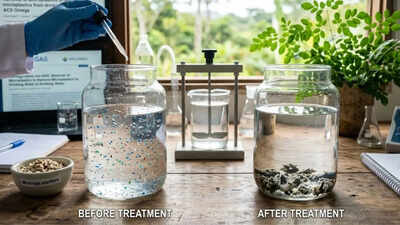
In Brazil, scientists at the Institute of Science and Technology of São Paulo State University (ICT-UNESP) are working on a new way to safely treat drinking water. They have found that a saline extract from the seeds of Moringa oleifera can be used to remove microplastics from drinking water. By taking advantage of the coagulant properties of moringa seed extracts, researchers have developed a sustainable and low-cost method for removing microplastics from drinking water. The performance of this natural coagulant is comparable to or better than that of traditional chemical coagulants, such as aluminum sulfate. According to the study published in ACS Publications, unlike chemical offerings, moringa seed extracts do not leave behind toxic residuals. This breakthrough represents an important step toward reducing the presence of microplastics in our water supply by using naturally-based, biodegradable technology.
Moringa oleifera seed can remove microplastics from drinking water
This study ‘Removal of Microplastics from Drinking Water by Moringa oleifera Seed: Comparative Performance with Alum in Direct and in-Line Filtration Systems’, shows that extracts from the Moringa oleifera tree can be used as a natural coagulant to help clean the water from microplastics. The microplastics and other contaminants in water carry a negative charge, which keeps the particles from coming together and causes them to remain suspended in the water. However, when moringa seed extract is added to the water, the negative charge on all of the particles is neutralised, causing the microplastics to coalesce into larger clumps through a process called flocculation. This allows for much easier removal of these clumps using sand filtration systems.
Moringa outperforms traditional treatments in challenging conditions
Researchers completed laboratory testing of polyvinyl chloride (PVC) microplastics, as they are known mutagens and carcinogens in regard to human health. The moringa extract was shown to have a similar performance when tested with a jar test method as aluminum sulfate. However, in more alkaline water conditions, the moringa-based coagulant performed better than traditional chemical coagulants, thus establishing the viability of using moringa in a variety of water treatment settings.
Advanced analytical methods confirm Moringa’s reliability
As noted in the study published on ACS Publications, the researchers did more than just conduct regular tests on the PVC microplastics in water; they exposed the PVC to UV rays to effectively simulate how the PVC would degrade if it were floating in water in a non-controlled setting. They then used advanced analytical equipment, such as SEM (scanning electron microscopy), to determine how many particles had been reduced in number, and high-speed cameras and laser measurements to observe the aggregate size of the flocculated particles. These methods confirmed that the moringa extract was still effective under the same types of environmental conditions as would be expected from actual contamination found in a natural water source.
The natural advantage of Moringa
Traditional water treatment coagulants, such as those based on aluminum and iron, are not biodegradable. These conventional methods also leave behind residual toxicity, which has raised regulatory questions. In contrast, the researchers have introduced moringa as a more environmentally sustainable alternative coagulant for water treatment, especially in less populated areas that cannot afford the complicated and bulky infrastructure needed to chemically treat water. Since moringa is a naturally existing, edible seed, its use will help to reduce the overall ecological impact of the water treatment process while addressing the widespread issue of microplastic contamination in human drinking water.