


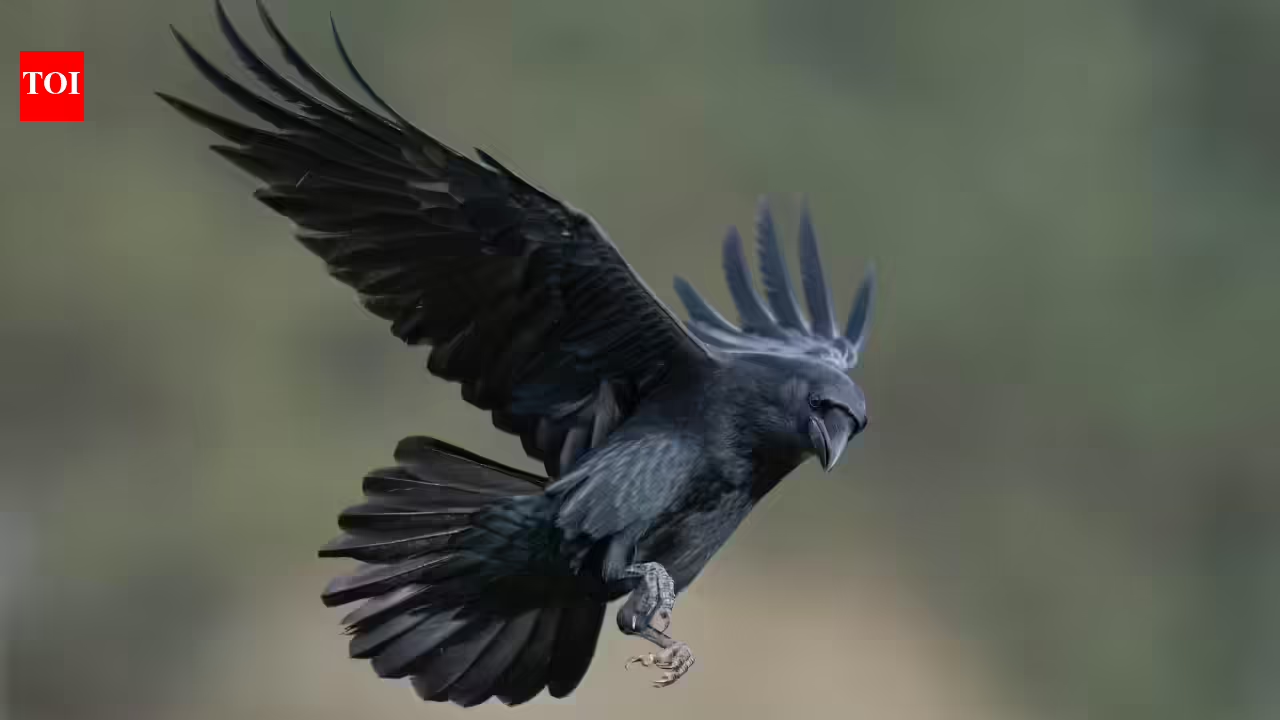
The ravens in the unique environment of the Dead Sea have evolved to adapt and live in the environment that very few animals can survive. The smart birds known to be brown-necked ravens, also known as Corvus ruficollis have successfully adapted to the hot desert-like environment by surviving in the area around the shores of the Dead Sea, eating whatever food is available. Although the Dead Sea area has very high salinity and temperature, there is a good behavioral adaptation, scavenging ability, and nest building by Dead Sea ravens.
Dead Sea’s extreme conditions: How ravens survive without freshwater
The Dead Sea, situated between Jordan and Israel, is one of the world’s saltiest water sources. Due to its extremely high saline content, there is no life in the water itself. Yet the cliffs and rocky surroundings around the Dead Sea make a peculiar habitat for specific animal species, such as ravens.It has been proven that ravens are one of the most versatile bird species. According to a study entitled “The Raven and the Sea: The Lost Intertidal World of Eighteenth-Century Ornithology,” Corvus ruficollis is a perfect adaptation to the desert climate. Since the birds obtain moisture from their prey, they can survive for a long time without drinking freshwater.
Feeding habits and behavioral intelligence of dead sea ravens
The ravens living close to the Dead Sea depend a lot on their intelligence and flexibility. By nature, ravens are scavengers who eat dead animal matter, insects, smaller reptiles, and even leftover food from people. Intelligence makes ravens capable of finding resources which could be missed by other creatures.In the behavioral paper’Why are ravens smart? Exploring the social intelligence hypothesis‘, it becomes evident that ravens show an extremely high level of intellect, being able to plan and make tools. It was found out that “ravens are capable of solving complex problems and modifying their feeding tactics due to environmental factors.”
nesting strategies in extreme desert cliffs
Another remarkable characteristic of ravens from the Dead Sea is their nesting process. Their nests are commonly located on the edge of precipitous cliffs, providing protection against predators and harsh weather conditions, including high temperatures at ground level.According to field observations quoted by the Department of Bioscience and Bioengineering, Indian Institute of Technology Jodhpurravens in deserts have the tendency to construct nests in isolated locations, minimizing competition.Such methods of nesting are said to be essential for survival in places with scarce food sources and high predation risk, as quoted by the Department: “Nesting on cliffs is essential in order to survive because of food scarcity.”Furthermore, the cliffs around the Dead Sea create an ecosystem with relatively lower temperatures.
Why these ravens matter? desert biodiversity
Despite being seen as isolated scavengers, ravens serve an important ecological function by consuming carrion, which helps keep diseases from spreading in the area and allows for nutrient recycling within the desert ecosystem.Their very existence in such inhospitable surroundings is a testament to the tenacity of life itself. The raven is considered an indicator species because its adaptability acts as a gauge of overall environmental suitability. The corvid family generally does well in varied habitats, which explains why they are able to provide some insight into the state of the ecosystem.Where there is no life in a body of water, these fearless ravens demonstrate how strong and adaptive nature can be.