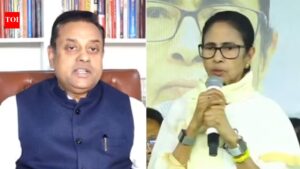
The BJP’s sweeping victory in West Bengal has redrawn one of India’s most important political maps. After 15 years of Mamata Banerjee’s dominance, the result marks not just a change of government, but a decisive rupture in a state where the Trinamool Congress had long appeared electorally resilient.It is also a result with consequences beyond Bengal. The verdict strengthens the BJP’s position in eastern India, weakens one of the most important regional pillars of the INDIA bloc, and raises difficult questions about whether the TMC can hold together after losing power.Political analyst Suvrokamal Dutta, who has traveled extensively across West Bengal, Assam and Puducherry during this and previous election cycles, offers an on-ground perspective on what changed in Bengal. In an interview with TOI+, he looks at the BJP’s emphatic rise, the Trinamool Congress’s loss of ground, the record turnout, and the impact of the Special Intensive Revision (SIR) of electoral rolls — an exercise that became one of the most contentious issues of the election. Edited excerpts:Q: How do you explain the scale of the BJP’s victory in West Bengal? What fundamentally shifted this time?This was something that was knocking at the door. Whether elections were held now or six months later, the result would have been the same. There are several reasons.First, there was extreme policy paralysis and governance failure, especially in Mamata Banerjee’s last two terms. When she came to power by defeating the Left, she used the slogan “Ma, Mati, Manush”, and people had huge expectations from her. But after the first term, things changed. What we saw was the rise of cut money, tolabaji — commission — and a network of local strongmen, what we call “para dadas” in Bangla, who controlled everyday life and extracted money at every step.Second, women’s safety became a massive issue. The “Maa” in her slogan was restless, as repeated incidents of crime took place and the government’s response to them created deep anger. The language used by Mamata Banerjee in some cases, which many saw as shaming victims, and the handling of these incidents alienated women voters across Bengal.Third, there were religious and cultural tensions. Controversies around Durga Puja, Kali Puja, Saraswati Puja (Mamta Banerjee government had imposed a ban on immersion of Durga idols during Muharram, she was also accused on adding stricter Covid-19 restriction during Durga Puja and Ram Navami festivals) and other festivals created a perception among many that their cultural identity was being undermined. This led to a huge polarization of Hindu votes in the state.Fourth, corruption became a major issue. There have been multiple scams, from recruitment to mining. Young people in Bengal felt cheated. Even after studying and qualifying, they were not getting jobs. All of this together created a huge backlash. People were just waiting for the opportunity to vote the government out.Q: Was this a vote for the BJP, or mainly a vote against the Trinamool Congress?It is both. It is definitely a vote against the TMC, but it is also a vote for the BJP. There was strong anti-incumbency against Mamata Banerjee, but that alone could not have resulted in such a landslide victory.The BJP’s strategy of focusing on schemes that were not being implemented in the state because of Mamata Banerjee’s political differences with the Center became a key narrative. The BJP also became a counterweight to the pro-minority votes that the TMC was banking on.The BJP kept highlighting the TMC’s misgovernance and continued to put the spotlight on women’s safety and employment. So yes, there was anger against the TMC, but there was also a conscious shift towards the BJP as an alternative.Q: Bengal recorded over 92% turnout, its highest ever. How did that shape the result?The voter turnout was definitely historic and was, in fact, an indicator of which way the results would go from the first phase of voting itself. Apart from the record turnout, what stood out was women’s participation being higher than men’s. Women’s turnout was close to 3-4% higher than that of their male counterparts. That is very important. It highlighted the level of anger, especially among women.Despite direct benefit schemes for women, unhappiness with the TMC had been building among female voters. High turnout generally amplifies sentiment. In this case, it amplified anti-incumbency.Q: The SIR of electoral rolls became a major flashpoint in Bengal, with Mamata Banerjee herself opposing it. Over 90 lakh names were excluded from the voters’ list. Who did this exercise hurt?Look, there may have been some genuine voters affected due to technical errors, and those should be corrected through hearings. But a large number of names removed were of duplicate voters, deceased persons, or people who had migrated. There were also cases where the same person was listed in multiple places. There were about 26 lakh cases in which names of people who had died were cleaned up.This exercise cleaned up the voter list to a large extent. Naturally, those who depended on such inflated lists would feel the impact, and most of these constituencies were those won by the TMC in 2021.Q: What were the Trinamool Congress’s biggest governance and strategic failures?The biggest failure was governance itself. You had a system where the para dadas had enormous control. Then there were corruption scandals, especially in jobs and recruitment. Young people were deeply frustrated. There was also confrontation with institutions and the Centre, which affected the implementation of schemes. All of this created a perception of misgovernance.Q: Did corruption and women’s safety become the tipping points against the TMC?Absolutely. Take the gang rape of a woman on Park Street in 2012, after which West Bengal Chief Minister Mamata Banerjee infamously dismissed the incident, calling it a “shajano ghotona” — a fabricated case — and a “misunderstanding” between the woman and her friends. The same attitude and absolute disregard for the victim and her family was seen during the RG Kar rape incident. There were allegations of attempts to destroy evidence and even harass the victim’s family. The mother of the victim later won on a BJP ticket.These issues were building up over time. Eventually, they reached a point where people could not ignore them anymore. When I was in Bengal during the elections, many women said: “We don’t need Lakshmir Bhandar (a flagship program launched by the West Bengal Government in February 2021, to provide financial assistance to women). We need respect.” That sentiment was very strong.Q: Did Hindu consolidation play a decisive role in this election?Yes, there was a clear consolidation, and it did not happen overnight. It built up over time. A section of voters felt that their cultural and religious identity was being undermined — whether through controversies around festivals like Durga Puja, Kali Puja or Ram Navami, or through what they perceived as selective political messaging. That created resentment at the ground level.At the same time, incidents of violence and the perception that the state was not acting firmly enough added to a sense of insecurity among many voters. These factors together led to what I would call a counter-polarisation. So the consolidation was not just political. It was also emotional and cultural. Many voters felt this election was about protecting their identity.and that translated into a more unified voting pattern in favor of the BJP.Q: What does this result mean for the future of the Trinamool Congress?This is a major setback, possibly a structural one. You will see internal churn. Some leaders and cadres may try to switch sides. There will also be legal and political challenges ahead for the party.Q: What does this result mean for the INDIA alliance, especially after setbacks to the TMC and DMK, and the split within AAP?The alliance had already weakened after 2024. This result weakens it further. The three strong regional parties that were backing it will have to bring their own houses in order, so any larger consolidation may take time. When key regional players face setbacks, the alliance loses its core strength. At this point, it exists more on paper than in political reality.
‘Cut money, tolabaji and para dadas led to Mamata’s downfall’
The BJP’s sweeping victory in West Bengal has redrawn one of India’s most important political maps. After 15 years of Mamata Banerjee’s dominance, the result … Read more

by
No comments on ‘Cut money, tolabaji and para dadas led to Mamata’s downfall’
7 minutes
Read Time
About the Author

Previous Post
Next Post
Leave a Reply
Latest News






Stay Connected
Categories
Tags
Bhubaneswar latest news Bhubaneswar news Bhubaneswar news live Bhubaneswar news today bjp Breaking news Chennai latest news Chennai news Donald Trump Goa latest news Goa news Goa news live Goa news today Google news Guwahati latest news Guwahati news Guwahati news live Guwahati news today India India News India news today ipl IPL 2026 Lucknow Mumbai Indians New Delhi Patna latest news Patna news Patna news live Patna news today Rajasthan Royals Ranchi latest news Ranchi news Ranchi news live Ranchi news today Ranveer Singh Royal Challengers Bengaluru Strait of Hormuz Today news Today news Bhubaneswar Today news Goa Today news Guwahati Today news Patna Today news Ranchi Uttar Pradesh
About the Author

AF themes
Easy WordPress Websites Builder: Versatile Demos for Blogs, News, eCommerce and More – One-Click Import, No Coding! 1000+ Ready-made Templates for Stunning Newspaper, Magazine, Blog, and Publishing Websites.

Search the Archives
Access over the years of investigative journalism and breaking reports
You May Have Missed