



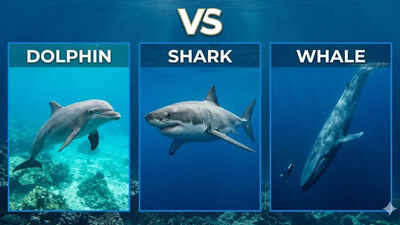
Life around the ocean surface can appear strangely similar from a distance. A dorsal fin cuts through the water, a dark body rises briefly to breathe, and then disappears again. Dolphins, whales and sharks are often grouped in popular imagination because they occupy similar marine habitats and share certain hunting behaviours. The biology behind them is far less alike than many people assume. Sharks existed long before dinosaurs appeared, while whales and dolphins evolved from land mammals that gradually adapted back to marine life over millions of years. Their bodies sometimes resemble one another because oceans shape animals in similar ways, yet the structures beneath the surface tell very different stories. Teeth, breathing, reproduction, social behavior and even body temperature separate these marine animals far more than appearance suggests.
10 major differences between Dolphins, Sharks and Whales
Dolphins, Whales and Sharks: Ultimate sea life comparisons
1. Animal group
- Dolphins belong to the mammalian family despite living entirely in water. They share traits with land mammals, including warm blood and nursing their young.
- Whales are mammals as well, ranging from small species to some of the largest animals ever recorded.
- Sharks are fish, part of a much older marine lineage that developed separately from mammals.
2.Breathing method
- Dolphins breathe air through a blowhole on top of their heads, surfacing regularly throughout the day.
- Whales also rely on lungs and must return to the surface even during long deep-sea dives.
- Sharks use gills to extract oxygen directly from water, so they do not need to surface for air.
3. Body temperature
- Dolphins maintain a stable internal temperature regardless of surrounding water conditions.
- Whales stay warm through thick layers of blubber that help trap heat in colder oceans.
- Sharks are generally cold-blooded, meaning their body temperature changes with the water around them.
4.Skeleton
- Dolphin skeletons are made of bone and still contain limb structures inherited from ancient land ancestors.
- Whale skeletons are also bony, with flippers carrying traces of finger-like bones inside.
- Sharks have skeletons built mostly from cartilage, which is lighter and more flexible than bone.
5. Reproduction
- Dolphins give birth to live calves and care for them closely after birth.
- Whale calves stay with their mothers for extended periods while learning migration and feeding behavior.
- Shark reproduction varies between species, with some laying eggs while others give birth to live young.
6. Skin texture
- Dolphin skin is smooth and rubbery, helping reduce drag while swimming quickly.
- Whale skin is smooth too, though larger species often carry scars or barnacles across the body.
- Shark skin feels rough because it is covered with tiny tooth-like scales called dermal denticles.
7. Intelligence and communication
- Dolphins are known for social behaviour, coordinated hunting and complex vocal signals.
- Whales communicate through low-frequency calls, songs and long-distance sound patterns in the ocean.
- Sharks rely more on sensory detection than social communication and generally show less group interaction.
8. Feeding style
- Dolphins commonly feed on fish and squid, sometimes hunting cooperatively in pods.
- Whales have highly varied diets depending on species, from microscopic krill to large fish and squid.
- Sharks use different feeding strategies across species, including ambush hunting, scavenging and filter feeding.
9. Tail movement
- Dolphins swim by moving their tails vertically in an up-and-down motion.
- Whale tails move in the same vertical direction, powered by strong muscles along the spine.
- Sharks move their tails side to side, which is typical of fish movement underwater.
10. Evolutionary origin
- Dolphins evolved from land mammals that gradually adapted back to marine environments millions of years ago.
- Whales followed a similar evolutionary path, with fossil evidence linking them to hoofed land mammals.
- Sharks come from an ancient fish lineage that has existed in the oceans for hundreds of millions of years.
How dolphins, whales and sharks evolved into ocean giants
Despite sharing the same oceans, dolphins, whales and sharks represent three very different versions of marine survival. Dolphins are built around speed, social behavior and communication, whales combine immense size with long migrations and complex vocal systems, while sharks rely on sensory precision and evolutionary traits that have survived for hundreds of millions of years with relatively little change. One returned to the sea from land, another became the largest mammal on Earth, and the third remained an ocean predator long before either existed. Their differences are not simply biological details. They show how separate evolutionary paths can still produce animals capable of dominating the same underwater world in completely different ways.