


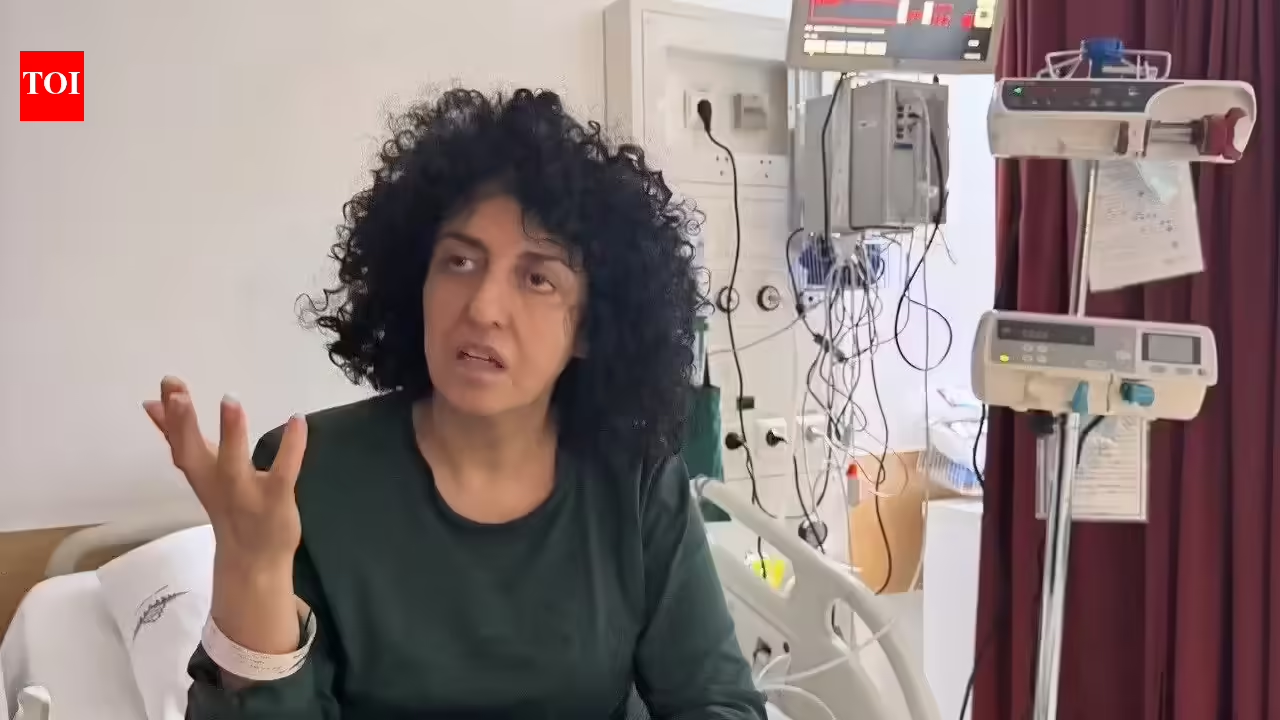
Prominent Iranian human rights activist Narges Mohammadi in a hospital in Tehran, Iran on May 10, 2026. (Narges Foundation Archive via AP)
PARIS: Iranian rights activist Narges Mohammadi won the Nobel Peace Prize in recognition of decades of campaigning, but her struggle has seen her separated from her family for over a decade and her health put at risk.Mohammadi, 54, was released on bail on Sunday from her latest stint in prison and urgently transferred to hospital in Tehran after supporters warned that her life was in danger due to ailing health.The award in 2023 by the Norwegian committee was a triumph for Mohammadi, who has spent much of the past two decades in and out of jail while campaigning on issues including abolishing the death penalty and the mandatory hijab for women in Iran.But, symbolically, she was not in Oslo to pick up the prize recognizing her life’s work as she was again in prison. The award was received by her twin teenage children Ali and Kiana, now 19, accompanied by her husband Taghi Rahmani.In giving the award to Mohammadi, the Nobel committee recognized that her “brave struggle has come with tremendous personal costs”.Her children, who now live with their father in exile in Paris, have not seen their mother for over a decade and have often not been able to even speak to her while she has been in prison. But they have been unstinting in their praise for her courage and choices.“My mother paid a high price. She worked very hard and was away from us for a long time. But when she was with me and Kiana, she was a wonderful mother,” said Ali in a statement read at a news conference this month in Paris.“If I have the chance to speak to my mother, it would be the same message as before: ‘My dear mother, know that you are not alone. The Iranian people are standing hand-in-hand.’”
Matter of life and death
Mohammadi had been on temporary leave from prison when she was last arrested in December, while speaking in the eastern city of Mashhad at the funeral of a lawyer who had died in what supporters saw as suspicious circumstances.In typically defiant style, she was not wearing the hijab and denounced the clerical system that has ruled Iran since the Islamic revolution of 1979.She was roughly arrested and beaten, according to supporters, before being transferred in February to another prison in Zanjan in northern Iran, where she suffered two suspected heart attacks. “Narges Mohammadi’s life hangs in the balance,” husband Rahmani said after she was moved to Tehran on Sunday. “Her freedom is a matter of life and death.”Despite her prominence abroad and the close attention of the judiciary, Iranian authorities and pro-government media have appeared wary of giving Mohammadi publicity. When she was arrested in December, the Fars news agency described her as “acting against national security” and accused her of being behind “sedition”.
Indescribable suffering
But defiance has always been second nature to Mohammadi, who staged sit-in protests even while behind bars in Tehran’s Evin prison as demonstrations rocked Iran in 2022 and 2023.In an interview with AFP carried out via written messages in September 2023, she said, “we must continue to fight and sacrifice” so long as freedom and democracy are not realized in Iran.“My most incurable and indescribable suffering is the longing to be with my children, from whose lives I departed when they were eight,” she acknowledged.According to her Paris-based legal team, Mohammadi has already spent over 10 years of her life in prison and now faces a accumulative total of 18 years on various national security charges.Born in 1972 in Zanjan, Mohammadi studied physics before becoming an engineer. But she then launched a new career in journalism, working for newspapers that were at the time part of Iran’s reformist movement.In the 2000s, she joined the Center for Human Rights Defenders, founded by the Iranian lawyer Shirin Ebadi, Nobel Peace Prize winner in 2003, where she fought in particular for the abolition of the death penalty.In her book White TortureMohammadi denounced the conditions of detention in Iran, in particular the use of solitary confinement, which she said she herself was subjected to.Amnesty International describes her as a prisoner of conscience who was arbitrarily detained.“I hope for the day when my mother and all the political prisoners are unconditionally freed and no more children in the world need to be separated from their mothers,” said her daughter Kiana.
About the Author

Previous Post
Next Post