


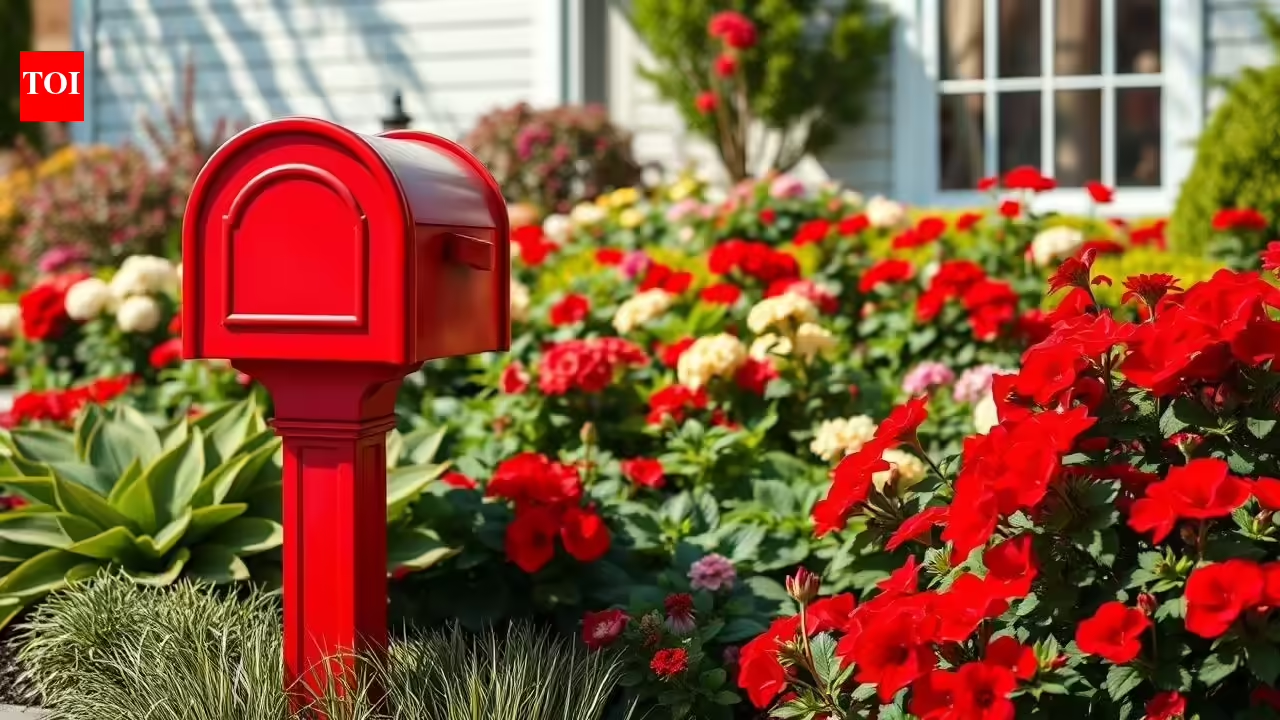
To most homeowners, the mailbox garden serves as the first introduction to their home. It is a very small yet high-pressure garden that sits right at the curb, and for some reason, it always seems impossible to maintain. In springtime, you plant some pansies and a little bush, only to see that by the time July rolls around, your garden has dried up to the point where nothing but sticks remain. Or, even more annoying, your plants have gotten out of control to the point where they are invading your walkway and mailbox.The struggle is real because a mailbox bed is essentially a “heat island.” It is surrounded by asphalt and concrete, reflecting intense glare and heat back onto the plants. It also faces the unique challenge of “hellstrip” conditions: lean soil, salt spray from winter roads, and the occasional foot traffic. To make it look full and lush by midsummer, you have to move past the “miniature jungle” approach and focus on a few high-performance anchors that can handle the stress without losing their shape.In accordance with a research guide on Creating a Hellstrip Garden Provided by Penn State Extension, the best roadside gardens are always based on hardy, salt-tolerant plants. Given their limited size, there is no need for an enormous selection of different types of flora. In fact, the ideal mailbox bed is made even more efficient by using only three layers in its design: a strong base, a repeated middle layer, and a neatly trimmed edge. Thus, the bed will become a well-composed piece of art, not merely a random collection of different elements.Selecting the best “workhorse” plantsTo achieve a mid-summer richness, one should choose plants that are able not only to survive but to actively flourish during the hottest days of the year. Annuals are usually the first choice among many gardeners; however, these flowers cannot withstand the high temperatures, so their lifespan does not last until August. Instead of annuals, one may opt for sturdy perennials that will grow rapidly within a short period of time. Daylilies are always the best solution.In a study on Daylilies by the University of Minnesota Extension, researchers point out that these plants are perfect for difficult sites because they are drought-tolerant once established and can handle a wide range of soil types. They offer a “mounded” shape that provides instant volume at the base of the mailbox post. When you group a few daylilies, they create a dense canopy that shades out weeds, keeping your maintenance low while your curb appeal stays high.
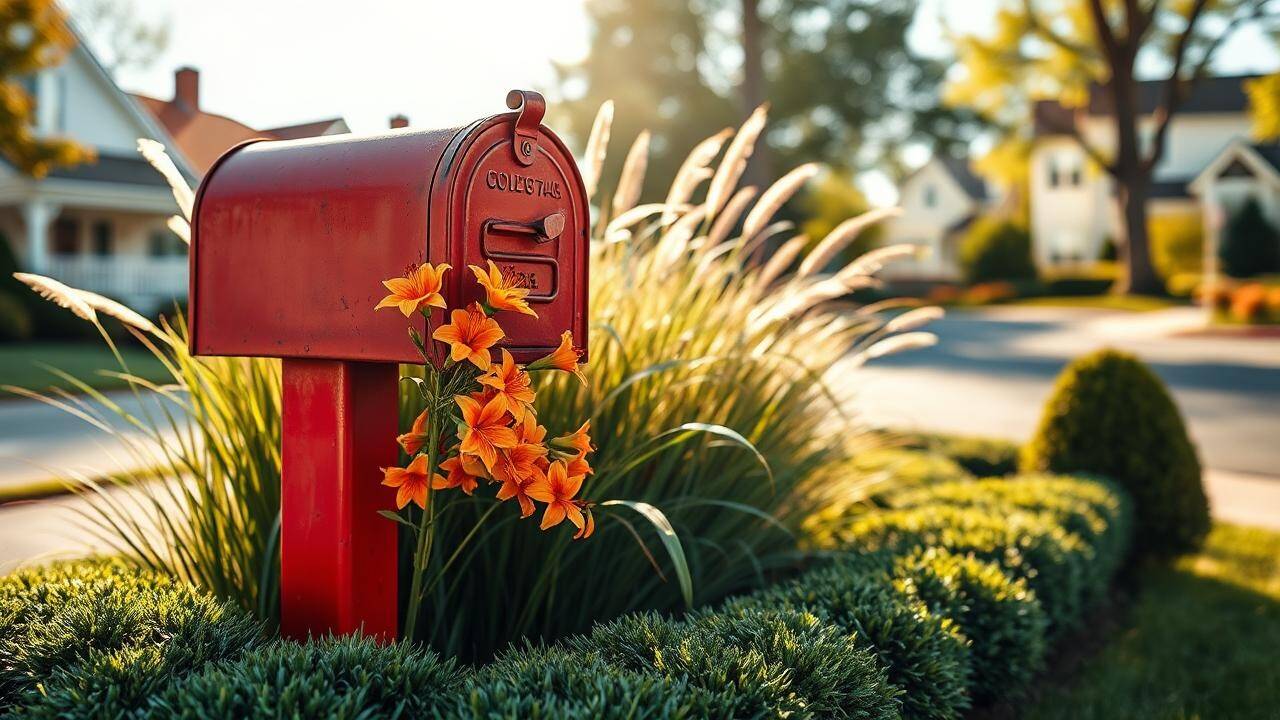
Daylilies offer volume and weed suppression, while vertical accents add dynamism. Proper plant density and mulching are crucial for a lush, low-maintenance display.
In order to prevent the overall appearance from being too bland, you need to include at least one vertical accent. It could be some taller plant, such as an ornamental grass or salvia. This will give you a sense of a ‘peak’ in the landscape, which will correlate with the high point of the mailbox post. Adding a slightly asymmetrical vertical accent makes your bed look more dynamic and interesting compared to the uniform border of annuals surrounding the mailbox post.The final touches for curb appealOften, the key to impeccable design lies in the details. Due to the limited size of a mailbox bed, even the smallest imperfection becomes obvious. For that reason, you need to finish it with edging plants, which would separate the garden from the walkway or the street itself. You can try using such low-growing plants as sedums or dwarf boxwoods for edging. It will create a ‘frame’, making the bed appear as a deliberately designed space despite wild midsummer plants growing within it.A further requirement for success is plant density. One of the most frequent mistakes is to have too much open ground between your plants because they will invite weed growth and make your planting appear “scrappy.” The correct way to plant is so that when your plants mature, their foliage barely touches one another to form a living mulch layer.Do not neglect the mulching process either. Adding a new layer of black hardwood mulch in the spring will do a lot more than just prevent weeds from growing. It will provide you with a sharp contrast that will help bring out even more beauty from your green plants and colorful flowers. With some daylilies as the structure elements and an organized edge, the bed around the mailbox will be ready to welcome the summer season.