



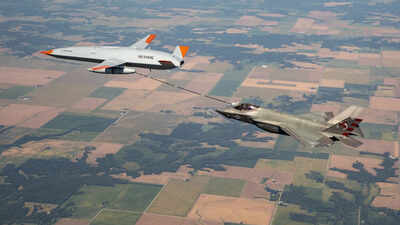
The United States Navy has flown its first production MQ-25 Stingray Unmanned Aerial System (UAS). The system will perform the role of a Carrier-Based Aerial-Refueling System (CBARS). This UAS has been flying and undergoing flight trials since 2019. The aircraft also underwent handling trials onboard the USS George HW Bush (CVN 77), aircraft carrier. The two-hour initial flight of the first production model will take the aircraft a step closer to deck-based flight operations.During this test flight, the aircraft executed a series of maneuvers to validate its integration with the Unmanned Carrier Aviation Mission Control System (UMCS) MD-5 Ground Control Station (GCS). The GCS for the MQ-25 was made by Boeing’s competitor Lockheed Martin (LM), whose own Sea Ghost UAS failed to make the cut for the CBRAS competition. The Sea Ghost is based on the RQ-170, which the Iranians forced down and built a copy of, as per the Times of Israel.The MQ-25 is expected to refuel other fixed-wing aircraft in the air. During its trial phase, the UAS demonstrated the ability to refuel other aircraft. The aircraft is also expected to perform Intelligence, Surveillance and Reconnaissance (ISR) roles, as well as acting as a flying relay station as part of a communication node in a kill web, the US Naval Institute reports.The US Navy was in need of an airborne refueling platform because 20-30% of US Navy’s F/A-18 Super Hornet sorties were for refueling other aircraft. The US Navy wanted to complete this job more cost-effectively and use its Super Hornets in a more judicious manner. At one point, the service considered reviving retired aircraft to withdraw the fighters from this role, as per Washington DC based Breaking Defense.The US Navy is also considering this autonomous, but man-in-the-loop capability to be a building block for more mature and advanced autonomous airborne technologies, as per Breaking Defense. Now, as work progresses globally on optionally manned fighter aircraft, including an autonomous platform to serve on the frontlines alongside manned fighters in a niche role may signal the beginning of a new era in aerial warfare.