

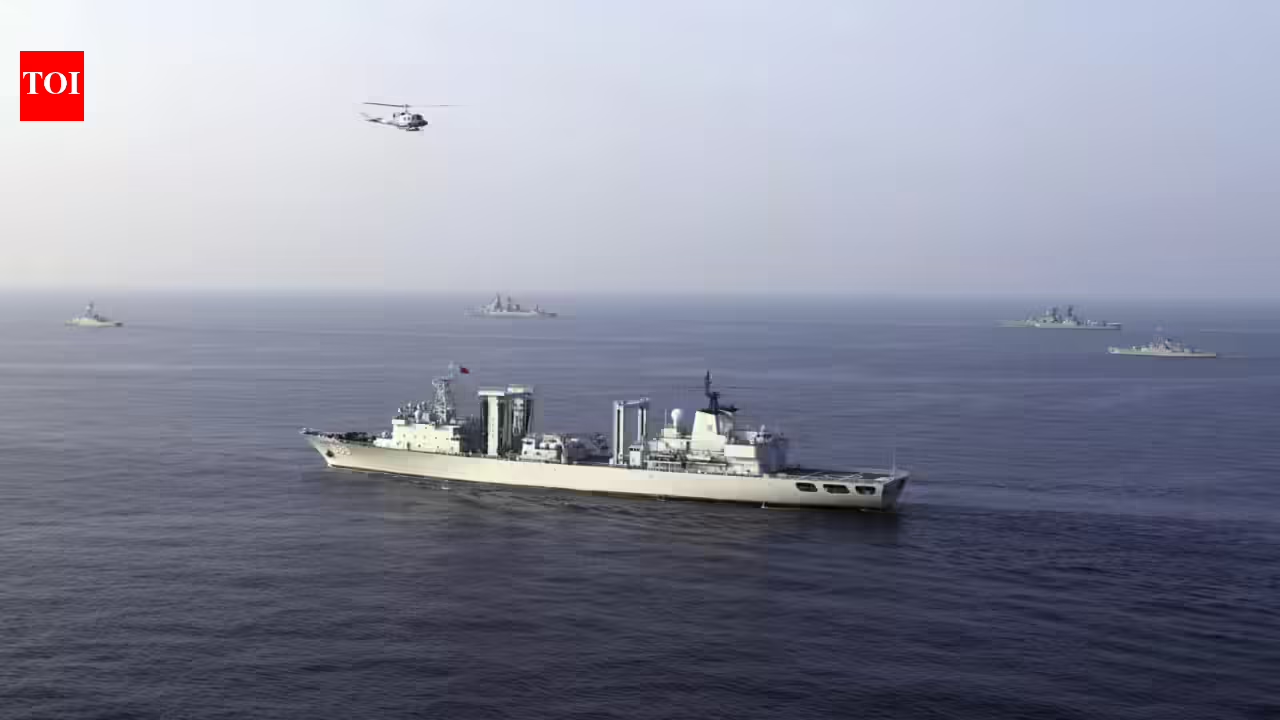
A Russian cargo ship, the Ursa Major, sank in unexplained circumstances about 60 miles off the coast of Spain after a series of explosions on December 23, 2024, according to a CNN investigation. The vessel is believed to have been carrying components of two nuclear reactors for submarines, possibly destined for North Korea.The ship, also known as Sparta 3 and previously used in Russia’s military campaign in Syria, left Russia on December 11. It had first docked at Ust-Luga in the Gulf of Finland and later at St. Petersburg. Its public manifest said it was bound for Vladivostok and listed cargo including two large “manhole covers,” 129 empty shipping containers, and two large Liebherr cranes. In October, its owner, Oboronlogistics, said its ships had been licensed to carry nuclear material.Time-lapse footage analyzed by CNN showed containers being loaded into the hull at Ust-Luga, with a gap left below where the “manhole covers” would later sit. The Spanish investigation later suggested the cranes may have been included to assist delivery of sensitive cargo at its destination.The ship then moved down the French coast, tracked by Portuguese Navy aircraft and vessels through their waters. Two Russian military ships, the Ivan Gren and Aleksandr Otrakovsky, escorted it. On December 22, the Portuguese navy stopped tracking the vessel.About four hours later, in Spanish waters, the ship slowed sharply, prompting Spanish rescuers to radio it to check whether it was in distress. The crew said it was fine.But around 24 hours later, the ship deviated from its course and at 11:53 am UTC on December 23, issued a distress call after suffering three explosions on its starboard side, likely near the engine room. Two crew members were killed. The vessel listed heavily and became immobile, as video footage later showed.The 14 surviving crew members evacuated in a lifeboat and were rescued by the Spanish salvage vessel Salvamar Draco. At 7:27 pm, a Spanish military vessel arrived on scene. Shortly after, the Russian escort ship Ivan Gren ordered nearby vessels to stay two nautical miles away and requested the return of the rescued crew.Spanish maritime rescue authorities insisted on conducting a rescue operation and sent a helicopter to inspect the ship.At 9:50 pm, the Ivan Gren fired red flares over the area. Four explosions followed, and seismic data recorded four matching signals at the same time and location, consistent with underwater mines or quarry blasts, according to the Spanish National Seismic Network. By 11.10 pm, the Ursa Major was reported sunk.The Spanish government released a statement on February 23 after pressure from opposition lawmakers. It said the ship’s Russian captain told investigators the vessel was carrying “components for two nuclear reactors similar to those used in submarines,” and that it was unclear whether they contained nuclear fuel.The source familiar with the investigation said the captain, identified as Igor Anisimov, believed the ship was being diverted to the North Korean port of Rason. The Spanish inquiry questioned the unusual route, noting the availability of rail transport across Russia, and suggested the cranes were intended to assist delivery of sensitive cargo upon arrival.The ship’s crew was later returned to Russia. Four days after the sinking, Oboronlogistics described the event as a “targeted terrorist attack” and said there were three blasts. It reported a 50 cm by 50 cm hole in the hull with metal bent inward and said, “The deck of the vessel was strewn with shrapnel.”A week after the sinking, a Russian military vessel, the Yantar—a research ship accused of espionage activity in NATO waters—arrived over the wreck and remained in the area for five days. During this period, four further explosions were detected, possibly targeting the wreck on the seabed. Tracking data also showed the Yantar had been in the region, including a position ping about 20 km from the ship’s last known location.The wreck of the Ursa Major lies at a depth of about 2,500 meters (8,202 feet) in the Mediterranean Sea. Spanish authorities said recovering its data recorder is not possible without significant technical resources and risks. Some experts questioned this assessment given the absence of confirmed radioactive material.