



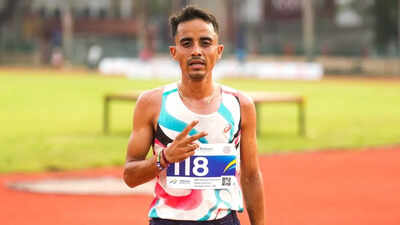
Sawan Barwal ran 2:11:58s at the NN Marathon Rotterdam, finishing 20th, but broke Shivnath Singh’s 1978 mark of 2:12:00 – India’s longest-standing national record in athletics, and he broke it in his first marathon itself. (Photo: Reliance Foundation Youth Sports)
In the hours after crossing the finish line in Rotterdam, Sawan Barwal did what most athletes do. He called home. But instead of celebrating, he told his family he was disappointed.“At that time, there was a sense of sadness that I could not achieve my target,” Barwal told Timesofindia.com in a recent conversation. “When I finished, the organizers there told me that I had broken India’s national record. But that was not my target. My target was to finish around 2:10. The record was not the target.”Earlier this month, Barwal ran 2:11:58s at the NN Marathon Rotterdam, finishing 20th, but broke Shivnath Singh’s 1978 mark of 2:12:00 – India’s longest-standing national record in athletics, and he broke it in his first marathon itself. Yet for Barwal it was not about the joy, but it was the weight of the two lost minutes. It was the gap between 2:10:00s and 2:11:58s – the target he had trained for and the time he eventually clocked.
The Marathon Transition
Barwal is 28 years old, a Havildar in the Indian Army, and until recently, a track runner. For most of his career, he ran the 5000 meters and 10000 meters – respectable distances, national-level performances, but nothing that made international headlines.Then, in 2023, AFI’s coach Scott Simmon suggested he try the marathon.“After the 10000 meters at the Asian Championship (2025), we had a discussion, and he (Scott Simmon) gave one suggestion: try a marathon once, you will do very well,” Barwal said. “I discussed it in India – with Army coaches, with Reliance – and at that time the plan was to try a full marathon in October (2025).”He didn’t make it to October. A week before the planned attempt, he got injured. Recovery took months. No walking. No running. Just waiting. By January 2026, Barwal returned to training in January and ran in the World Athletics Cross Country Championships in Tallahassee, where he finished 60th. By April, he was in Rotterdam with a single, unambiguous target: 2:08:00s to 2:10:00s“The training was going accordingly. My fitness was aligned with that,” he revealed. “My training partners, Man Singh and Tnonakal Gopi are very experienced. I learned a lot from them, even before the start we were discussing it is not a fight to the finish; it is a fight to get across – there is no chance of staying on the wrong side. Because for me, this was also an event shift, I was moving to a marathon. So mentally for me, it was important to get a good result in the first marathon, otherwise a question mark would arise.“For Barwal, the shift to marathon was not just tactical. He was betting his career on a distance he had never raced competitively. A strong debut was not an ambition. It was a necessity.
The Final Moments
For 35 kilometers, Rotterdam went to plan. “Up to kilometer 30, 34, 35, everything was going fine,” Barwal said about the race. “But suddenly, because of the wind and the cold air – it was completely cold there – and I made a mistake.”That mistake was pouring water on his head to cool down. With the dropping temperature, it became catastrophic.“Since there was not much sweating happening because it was dry, I poured water on my head. Maybe because of that, I started to freeze. There was swelling on the face. In between, I was trying, but I could not feel my face properly; there was some swelling.”What followed was what Barwal describes as disorientation. The last five kilometers were becoming a blur. Yet the mental target remained concrete.“In the last 4-5 kilometers, when it was about to end, I could feel things going sideways, whether it was the cold wind or the freezing. Till the very last, the only target was to reach the finish line. In the last few meters, I fell down. Both times, my eyes were only on the finish line, to finish before collapsing, so that nothing would happen at the finish line, just cross that line. Even while falling, my eyes were on the finishing point,” he said.The last 100 meters took a minute and a half. Almost walking pace, and that’s where Barwal lost out on his target of 2:10:00s. He was disappointed. But that phone call home helped him with much-needed perspective. “They explained that it was the first time, it was the first opportunity, and on the first attempt itself, you broke the national record, just celebrate that, and more opportunities will come, you can compete again and achieve that time,” he said, recounting the conversation with his family. “In these 48 years, so many runners must have dreamed of breaking the national record; it was a dream.“After talking to them, yes, then I felt I should enjoy and celebrate a little,” he said. “So absolutely, it is definitely an achievement.”
The Support Structure
Barwal’s confidence in targeting 2:10:00s did not emerge from nowhere. It came from the institutional support through Reliance Foundation and coach Ajith Markose, and from the Army’s long investment in his development.“In athletics, the morning session is 2-3 hours, around 7 to 10 or 11, and then if there is no support, making breakfast, food, and recovery gets heavily affected. So having all the meals and everything arranged is a very big help – we don’t need to look at anything else, just focus on training, and everything is happening on its own. The entire Reliance staff is helping in everything – from travel to return, everything is being taken care of. So it becomes easy for us.”
Next Target: Asian Games
Barwal’s time was enough to beat the Athletics Federation of India’s qualification standard of 2:15:04s for the 2026 Asian Games, while Gopi, who competed alongside Barwal, finished 23rd with a time of 2:13:16s. After Rotterdam, Barwal is focused on recovery and the Asian Games. When asked about his plan, Barwal understands that one breakthrough does not guarantee another. “Right now, the focus is on recovery, to recover as quickly as possible. Then the next focus is the Asian Games. In between, if there is any event, we will plan with the coaches and the Army.”But at the Asian Games, the target, Barwal made clear, was not about time. It was about positioning.“The target is to be better prepared for it. Because in competition, time does not matter – finishing position matters. It is a tactical race; who finishes fast at the end, or how the race goes up and down in between. So in competition, I also do not target time. My target is to prepare better than this, and the normal target – the main focus will be on the medal.”However, Barwal’s debut time of 2:11:58s does not solve that problem entirely. The global elite marathon times – the winning times in major marathons – still sit closer to 2:04 or 2:05. By world standards, 2:11:58 is strong, but not exceptional.Yet by Indian standards, it is transformational, and Barwal’s run signifies that the ceiling has moved, and the question is how many more times it will be moved.
About the Author

Previous Post
Next Post